While nations rally to reduce their carbon emissions, and try to adapt at-risk places to hotter conditions, there is an elephant in the room: for large portions of the world, local conditions are becoming too extreme and there is no way to adapt. People will have to move to survive.
Over the next fifty years, hotter temperatures combined with more intense humidity are set to make large swathes of the globe lethal to live in. Fleeing the tropics, the coasts, and formerly arable lands, huge populations will need to seek new homes; you will be among them, or you will be receiving them. This migration has already begun…
Billions of people have gained clean water, sanitation and hygiene in the last nine years. That’s not a typo – that’s billions, with a B. An astonishing new data dump from the WHO and UNICEF showing that between 2015 and 2024 humanity recorded one of the fastest expansions of basic welfare of all time: 961 million people gained safe drinking water, 1.2 billion gained safe sanitation, and 1.5 billion gained access to basic hygiene services, while the number of unserved fell by nearly 900 million. Coverage has risen to 74%, 58% and 80% respectively, while open defecation has dropped by 429 million people. Together, these figures represent an historic advance in human health and dignity.
According to textbook economics, the stock market’s value reflects what are known as “fundamentals.” An individual company’s current stock price is derived from that firm’s future-earnings potential, and is thus rooted in hard indicators such as profits and market share…
The fundamentals story held up well until the 2008 financial crisis. Within six months of the U.S. banking system’s collapse, the market fell by 46 percent. In response, the Federal Reserve cut interest rates to almost zero and pushed money back into the economy by purchasing trillions of dollars in securities from financial institutions… For most of the 2010s, corporate earnings were modest, GDP and productivity growth were low, and the labor market remained weaker than it had been before the crisis. In other words, the fundamentals were not great. Yet the stock market soared. From 2010 to 2019, it tripled in value.
More than half of the S&P 500’s total growth in 2023 and 2024 was driven by the so-called Magnificent Seven companies: Apple, Amazon, Alphabet, Meta, Microsoft, Tesla, and Nvidia. During those two years alone, Tesla’s value rose by 286 percent, Meta’s by 355 percent, and Nvidia’s by 861 percent. The biggest firms have always been responsible for a disproportionate share of the market’s growth, but never had the gains been so acutely concentrated.
So what the heck is going on?
Thanks to a series of regulatory changes in the late 2000s and early 2010s, about half of fund assets are now held in “passive funds.”… The most common type of passive fund purchases a tiny share of every single stock in an index, such as the S&P 500, proportional to its size.
We have a positive feedback loop here, friends. “Positive” does not mean “good,” it means “self-reinforcing.” A negative feedback loop tends to suppress its own growth: for example, a thermostat raises the heat if the temperature is too low, or raises the A/C if the temperature is too high. An example of a positive feedback loop is a microphone that’s too close to the speakers: it picks up music or speech, plus the sound from the speakers, and feeds that to the speakers, which get louder, and repeat until screech. Unregulated positive feedback loops always end in disaster.
As the “Magnificent Seven” become larger parts of the Fortune 500, passive funds buy more. Which makes the Seven larger, so passive funds buy more. Repeat until… well, I don’t know what will happen. But it will probably be unpleasant.
And good news from Fix the News: Sometimes no news really is good news!
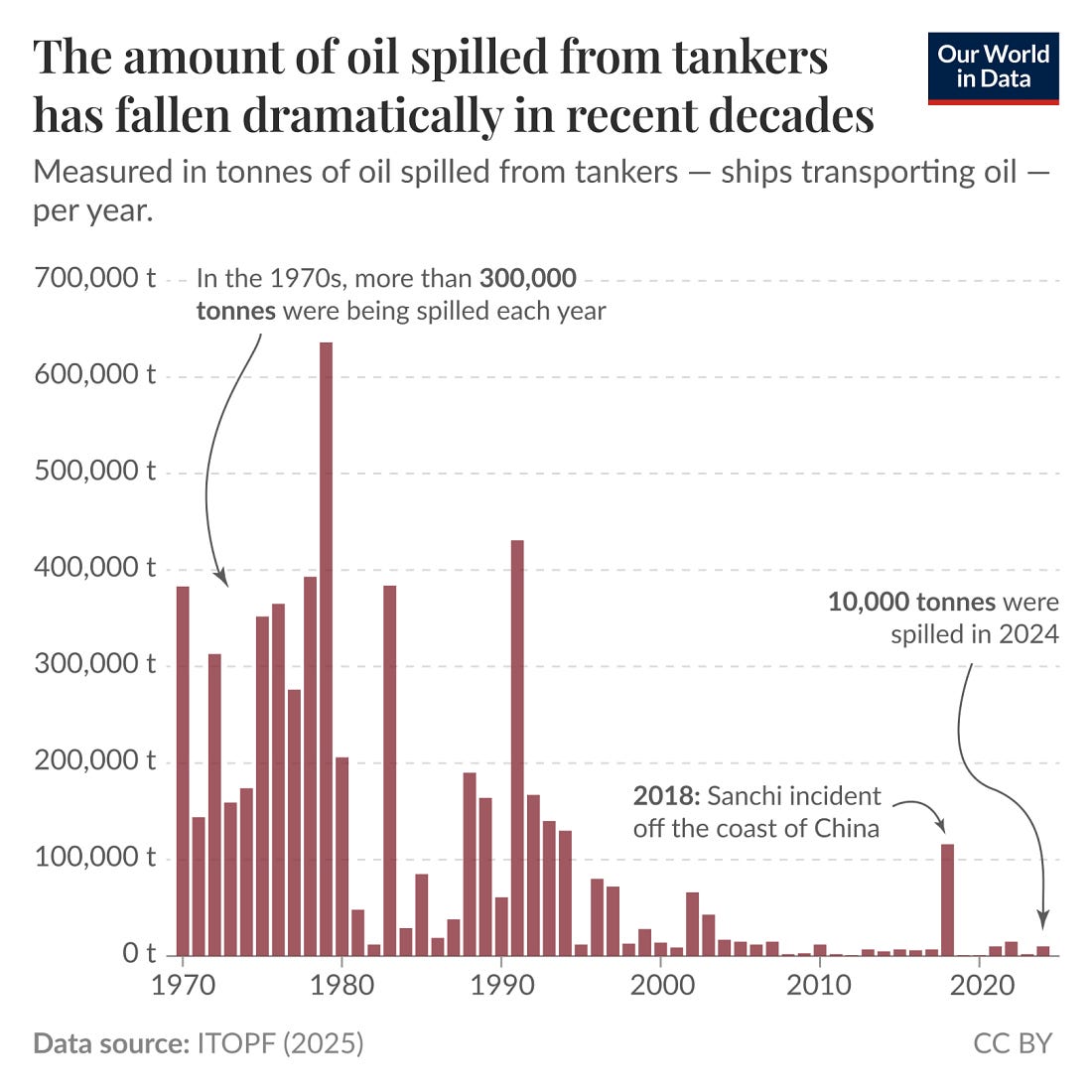
Oil tanker spills have nearly vanished since the 1970s. Half a century ago, spills released an average of 314,000 tonnes of oil into the ocean each year. However, better ship design, stricter regulation, and faster response capacity have turned once-routine disasters into rare events; today, the figure is below 10,000, less than one-thirtieth of its former level.Our World in Data
In my opinion, we’re living in a Golden Age, especially regarding healthcare. But these numbers are pretty astounding: global GDP in the year 1 was around $248 billion, in 1001 around $285 billion (up about 15%), in 1993 around $62 trillion (up around 24,876%). It’s routine to build massive civilian infrastructure: roads, hospitals, schools, bridges, and not just out of wood or stone anymore…
This article has some more detail: https://www.visualcapitalist.com/mapped-gdp-per-capita-worldwide/: “In 1990, 1.9 billion people lived in extreme poverty, which was 36% of the world’s population at the time. Over the last 30 years, the number has been steadily decreasing — by 2030, an estimated 479 million people will be living in extreme poverty, which according to UN population estimates, will represent only 6% of the population.”
This is a growth rate of world GDP of 87% in the 120 years 1700-1820; 311% in another hundred years from 1820-1920; and 2,390% in 103 years from 1920-2023. What will just the next 25 years present to us?
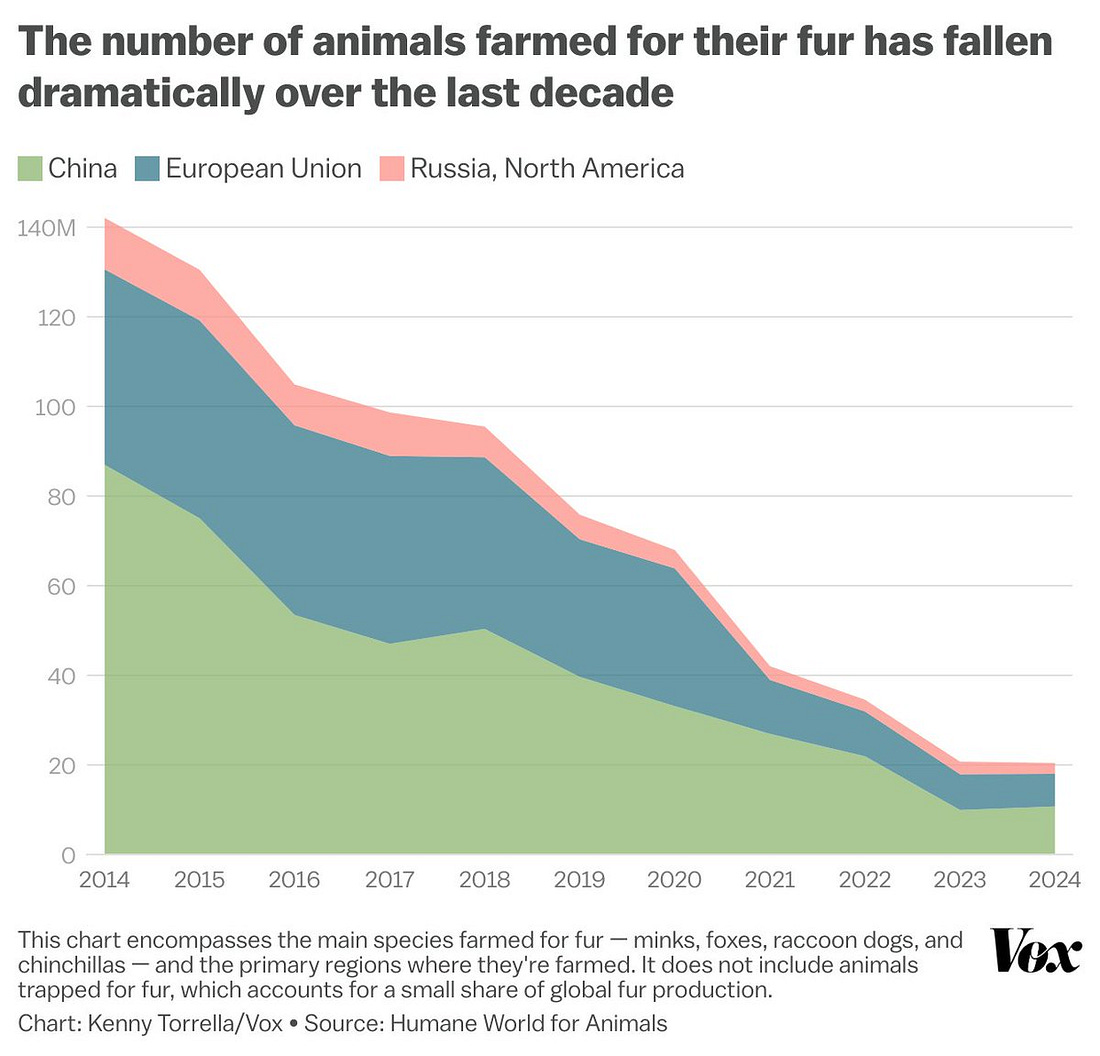
Check out fur’s fall from grace: a $40 billion industry gutted in a decade. In 2014, fur farms killed over 140 million animals. By 2024, that number was down to 20.5 million. The collapse came fast: Gucci’s 2017 fur-free pledge set off a luxury brand exodus, COVID-19 outbreaks on mink farms shut down operations across Europe, and sanctions and crackdowns hit demand in Russia and China. Vox says it’s the greatest animal welfare victory of the 21st century.





 Laugh / learn links log