On March 28, 2026, over eight million people attended more than 3,300 “No Kings” protests across the country, making it the largest single-day demonstration in US history, according to organizers. Buzzfeed seems to really like these: here are three links to pics of signs:
Good news from Fix the News: Our President has (totally by accident) greatly advanced interest in switching from foreign oil as an energy source to locally-produced green energy:
Iran shock speeds the shift from fossil fuels to electrification. The data is starting to come in: the Iran war is acting as an accelerant for clean energy. As oil and gas volatility pushes up costs, households from Britain to India and Pakistan are turning to EVs, solar, heat pumps and induction stoves as a hedge. These shifts will not stay local: when major economies accelerate the transition, others follow, creating spillover effects that outlast the crisis. Bloomberg / PV Magazine / CleanTechnica
And an image from my collection:
(xkcd.com/3199. The mouse-hover text is “Ugh, I’m never going to be like spiders. My descendants will all just be normal arthropods who mind their own busines and don’t do anything weird.” –The ancestor of a bunch of eusocial insects.)
My takeaway from this article was the importance of taking charge of your own (or your husband’s) medical treatment.
Joel elected to have a hip replacement. He counted on it to improve his quality of life.
Instead, a nick from the retractor caused a life-threatening bleed that set off a cascade of catastrophes. Within a few hours, he went from a healthy, active, 63-year-old to an unconscious, life-support-dependent ICU patient. Kidney failure followed, plus an obstructed colon and compartment syndrome — all complications of what should have been a routine procedure.
To make matters worse, the doctor who fucked up his hip replacement was in charge of fixing the mistake. Joel instead embarked on a months-long hospitalization with no guaranteed survival….
Just minutes before, a nurse had told me one doctor advocated amputating Joel’s leg; the other disagreed. The argument continued.
Why only two doctors instead of a larger team? I wondered. Why did they not ask my opinion? Who would make the ultimate decision?
That’s when a rabbi came to see me. “You can request a different hospital,” she told me calmly. “You could have your husband transferred.”
Those six words seemed so obvious…
Now, before every doctor appointment, I compose a list of questions, complaints and possible treatments. When a doctor pooh-poohs a test, I challenge their opinion. When a nurse minimizes a symptom, I repeat my concern. When a result goes unnoticed, I call attention to it. And my advocacy goes beyond medicine. When I appeared in court on a probate issue, I wrote a script for my lawyer with points to make to the judge.
Child mortality down 60% in two generations, as low-cost tools save millions. Since 1990, global under-five deaths have fallen from 13 million to 4.9 million a year, one of the largest public health gains in human history. Vaccines, oral rehydration, bed nets and safer births have been at the heart of this, with deaths from diarrhoea down 75% and malaria by 63%. Although progress has slowed in the last decade, the tools to prevent most remaining deaths exist. The gap is now political will rather than innovation. UNICEF
One thing I ask of you (Okay) Time to learn your homophones is past due (Woo) Learn to diagram a sentence, too Always say “to whom”, don’t ever say “to who” (Woo) And listen up when I tell you this I hope you never use quotation marks for emphasis (Woo)
Adult smoking in the United States has dropped below 10% for the first time. New analysis of national survey data found that cigarette use fell from 10.8% of adults in 2023 to 9.9% in 2024 (about 25 million people) down from 42% in 1964. The shift has helped drive a long fall in cancer mortality, with the American Cancer Society estimating reduced smoking prevented nearly four million lung cancer deaths between 1970 and 2022. Gizmodo
Plus an image from my collection, in honor of (recently) St. Patrick’s Day:
Here’s the story of how the Big Bang’s fifth and final great prediction was confirmed.
…As time went forward ((from the instant of the Big Bang)), the Universe would cool, expand, and gravitate all together. First atomic nuclei would form from protons and neutrons, then neutral atoms would form, and then gravitation would lead to stars, galaxies, and the grand structures of the cosmic web. These leftover relics — the light elements formed in the Big Bang, the relic photons from the primordial plasma, and the large-scale structure of the Universe — would, along with the cosmic expansion of the Universe, form the four modern cornerstones of the Big Bang.
But remaining from an even earlier epoch, a fifth cornerstone should exist as well. There would be an early signal left over from when the Universe was just one second old: a bath of neutrinos and antineutrinos. Known as the cosmic neutrino background (CNB), it was theorized generations ago but was dismissed throughout the 20th century as being fundamentally undetectable.
River otters have staged a remarkable comeback across North America’s Great Lakes after disappearing from many waterways by the 1970s. Reintroductions beginning in the 1980s, combined with wetland restoration and pollution controls under the 1972 US–Canada Great Lakes Water Quality Agreement, have allowed breeding populations to recover across Ohio, New York, Ontario and beyond. As apex predators, their return signals cleaner water and healthier ecosystems. Rewilding Magazine
Sweden cuts shootings by 63% after policing overhaul. Gun violence in Sweden has dropped sharply since peaking in 2022, with shooting incidents falling to 147 in 2025, down from the 390 recorded three years earlier. Authorities attribute the shift to expanded surveillance powers, tougher sentencing and new police tactics targeting criminal networks, which have also improved asset seizures and disruption of gang operations. Reuters
If it’s possible in Sweden (in just three years), maybe it’s possible here…
And an image from my collection. People’s profile pictures on dating sites often include other people; for privacy, many people will “scratch out” the faces of the others:
Tips on safely using your Constitutional rights to free speech in the face of authoritarian tactics. Summarized:
After Alex Pretti was fatally shot by an Immigration and Customs Enforcement (ICE) agent in Minneapolis, eyewitness cellphone videos became a powerful tool to contradict the Trump administration’s version of what had happened.
The Trump administration called Pretti “an assassin,” but videos show Pretti helping a protester who got pepper sprayed before he is pinned to the ground and shot. The Department of Homeland Security initially alleged in a statement that Pretti approached officers with a handgun, which is not supported by publicly available videos that show him clearly holding a cellphone when officers approached him.
People have the right to record law enforcement in public spaces under the First Amendment, but federal government officials have denounced people who do so. Last year, Department of Homeland Security Secretary Kristi Noem said that videotaping agents when they are out on operations is “violence.”
“There’s no guaranteed safe way to record ICE right now,” explained David Huerta, senior digital security trainer at Freedom of the Press Foundation. “There are ways to at least do so with as many safety measures as one could put in place.”
1. Before Filming, Prepare Yourself And Your Phone.
Burner phone, strong password, updated OS, and “Do this kind of activity with neighbors on your block or in pairs.”
2. While Filming, Narrate What You See For Verification Later.
“Make sure to mention the time, the date and an approximate location…” ((many details under the acronym “SALUTE”))
3. While Filming, Remember You’re There To Document.
Nathan-Pineau said she doesn’t encourage people to follow ICE officers back to their house.
4. While Filming, Ask The Person Being Arrested If They Want To Share Contact Info.
5. Focus Camera On Agents, Not People Being Detained.
If you do capture a person’s face, Nathan-Pineau advises against immediately sharing that video without obscuring the detained person’s face in some way.
6. Preserve Footage If Your Phone Gets Taken.
If you believe your phone is about to be seized by an officer, hit the stop button on the recording and turn the phone completely off. This “is probably the best protection, because then it’s in a fully encrypted state at that point,” Huerta said.
7. After Filming, Don’t Edit Your File.
(…)
After a federal agent fatally shot Renee Good in her car in Minnesota, Gov. Tim Walz asked residents to “carry your phone with you at all times” and “hit record” when they see ICE agents in neighborhoods.
“Help us create a database of the atrocities against Minnesotans, not just to establish a record for posterity, but to bank evidence for future prosecution,” he said.
Good news from Fix the News (info on dengue, AKA “breakbone disease” because of the great pain that some victims suffer):
Singapore demonstrates that specially-bred mosquitos can keep dengue suppressed at city-scale. Wolbachia is a bacterium that lives in many insects; when scientists breed male Aedes aegypti mosquitoes with it, those males don’t bite, and when they mate with wild females the eggs don’t hatch.In a 24 month trial across 15 residential areas in Singapore, this approach slashed wild female mosquitoes by around three‑quarters and reduced symptomatic dengue risk by roughly 70%.Medical Xpress
Many economists insist that this will all be fine. Capitalism is resilient. The arrival of the ATM famously led to the employment of more bank tellers, just as the introduction of Excel swelled the ranks of accountants and Photoshop spiked demand for graphic designers. In each case, new tech automated old tasks, increased productivity, and created jobs with higher wages than anyone could have conceived of before. The BLS projects that employment will grow 3.1 percent over the next 10 years. That’s down from 13 percent in the previous decade, but 5 million new jobs in a country with a stable population is hardly catastrophic.
And yet: There are things that economists struggle to measure. Americans tend to derive meaning and identity from what they do. Most don’t want to do something else, even if they had any confidence—which they don’t—that they could find something else to do. Seventy-one percent of respondents to an August Reuters/Ipsos poll said they’re worried that artificial intelligence will “put too many people out of work permanently.”
A detailed account of what’s happened in the past, whether it will apply to this very different new technology, and what the numbers show (briefly, it’s too soon to tell)…
Acemoglu, who won the Nobel Prize in Economics in 2024, studies inequality; Autor focuses on labor. But both insist that the story of AI and its consequences will depend mostly on speed—not because they assume lost jobs will automatically be replaced, but because a slower rate of change leaves societies time to adapt, even if some of those jobs never come back.
AI reads brain MRIs in seconds and flags emergencies. Researchers at the University of Michigan have developed an AI system that can analyse scans in seconds, identifying neurological conditions with up to 97.5% accuracy while also triaging urgency. Tested on over 30,000 MRI scans, the model flags strokes and haemorrhages for immediate attention, offering a potential fix for radiology backlogs and delayed diagnoses as MRI demand outpaces specialist capacity. Science Daily
In the past several years, CPAPs have become all the rage. (I use one myself.) It’s important to get sleep apnea treated, because it can lead to health problems:
Within a few years of starting CPAP, about 50% of patients use it too infrequently or stop completely. Left untreated, sleep apnea contributes to serious health issues including heart disease, strokes, and diabetes.
Some people have sleep apnea for different reasons:
Sometimes airways are obstructed at least partly due to certain facial and oral structures, like a recessed jaw or large tongue, that make it harder for CPAP alone to open the airway enough, even if the mask fits well, Motz says. Less common than obstructive sleep apnea is another form called central sleep apnea, in which breathing muscles aren’t active enough. For these patients, CPAP may not help as much.
Ways to improve your CPAP usage? Often it’s getting a mask that fits properly:
Nose-only masks are generally most effective, but masks that extend over the mouth can benefit those who struggle with nasal breathing… Accessories can make CPAPs more usable, such as snug cushion covers and stands that hold the CPAP hose above the head and out of the way. A chin strap to keep the mouth closed is another strategy shown to improve tolerance for CPAP.
Another approach is working with a cognitive behavioral therapist to address insomnia symptoms, claustrophobia, or anxiety posed by CPAP.
Lifestyle behaviors can help right now. For many people, reducing weight through exercise and healthy nutrition is a powerful strategy to counter sleep apnea. “If your weight goes up, you’re fighting an uphill battle,” Motz says. Dropping 10-15% can reduce sleep apnea severity by about 50%.
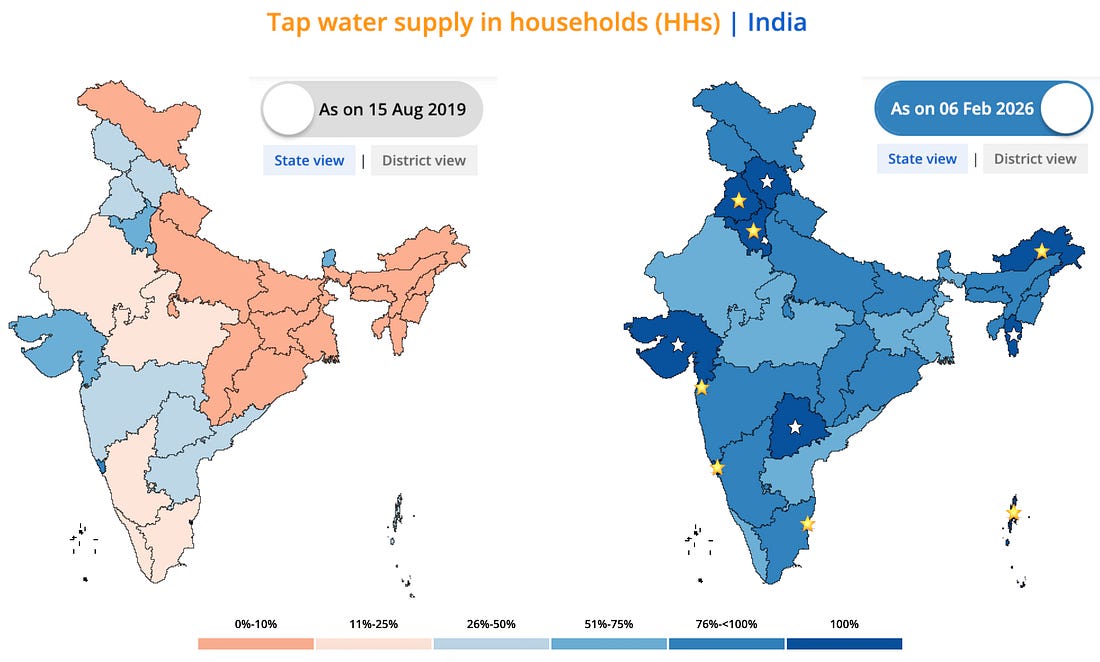
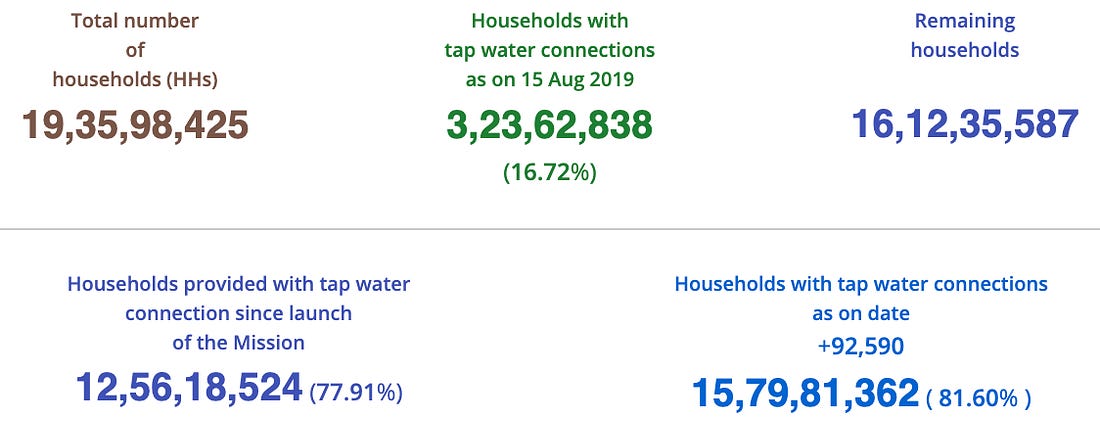
India has expanded rural tap water access from 16.7% of the population in 2019 to 81% in 2026 ((that’s seven years!)), connecting 125 million rural households to clean, running water. In sheer numbers, this is the biggest, fastest, and most important sanitation drive in human history. Why has it not been more widely reported? PIB Delhi
The website NotAlwaysRight.com has listed its 25 highest-rated inspirational stories of 2025: small interactions with people that turned out really nice. Some of the titles:
Bogotá’s care blocks are buying women their time back. Colombia’s capital is home to eight million people, and 1.2 million women who do more than ten hours a day of unpaid care. Since 2020 though, the city has opened 25 neighbourhood hubs where caregivers can drop off children or elderly relatives, do the laundry, then use free legal aid, training or mental-health support – or just sit down and read a book. The model is now spreading to Sierra Leone, Mexico and (soon) the United States. Vox
“A handful of global oligarchs with extreme wealth have bought up our democracies; taken over our governments; gagged the freedom of our media; placed a stranglehold on technology and innovation; deepened poverty and social exclusion; and accelerated the breakdown of our planet,” (the open letter to the World Economic Forum in Davos) reads. “What we treasure, rich and poor alike, is being eaten away by those intent on growing the gulf between their vast power and everyone else.
“We all know this. When even millionaires, like us, recognise that extreme wealth has cost everyone else everything else, there can be no doubt that society is dangerously teetering off the edge of a precipice.”
Poland moves to recognise same-sex couples. Poland’s government has approved a bill introducing “cohabitation contracts” for couples living together regardless of gender – its first nationwide legal recognition of queer relationships. The bill, which covers health, housing and tax rights, stops short of marriage, but activists say it’s the only one with a real shot of passing in the current parliament. Reuter







 Laugh / learn links log