The website NotAlwaysRight.com has listed its 25 highest-rated inspirational stories of 2025: small interactions with people that turned out really nice. Some of the titles:
Bogotá’s care blocks are buying women their time back. Colombia’s capital is home to eight million people, and 1.2 million women who do more than ten hours a day of unpaid care. Since 2020 though, the city has opened 25 neighbourhood hubs where caregivers can drop off children or elderly relatives, do the laundry, then use free legal aid, training or mental-health support – or just sit down and read a book. The model is now spreading to Sierra Leone, Mexico and (soon) the United States. Vox
“A handful of global oligarchs with extreme wealth have bought up our democracies; taken over our governments; gagged the freedom of our media; placed a stranglehold on technology and innovation; deepened poverty and social exclusion; and accelerated the breakdown of our planet,” (the open letter to the World Economic Forum in Davos) reads. “What we treasure, rich and poor alike, is being eaten away by those intent on growing the gulf between their vast power and everyone else.
“We all know this. When even millionaires, like us, recognise that extreme wealth has cost everyone else everything else, there can be no doubt that society is dangerously teetering off the edge of a precipice.”
Poland moves to recognise same-sex couples. Poland’s government has approved a bill introducing “cohabitation contracts” for couples living together regardless of gender – its first nationwide legal recognition of queer relationships. The bill, which covers health, housing and tax rights, stops short of marriage, but activists say it’s the only one with a real shot of passing in the current parliament. Reuter
We all lose things occasionally. Here are some techniques for finding them again (the entire article with some slight cuts):
What to do if you’ve lost a wallet
Look up your last credit card transaction, and then go to the place where you last spent the money and look around there.
Watch things fall as you drop them
I have trained myself to watch things fall when I drop them. If you watch a small screw fall and see where it lands and bounces, you will have no trouble finding it. If you just look at the place where the screw was supposed to go and growl and curse, expect to have trouble finding it.
Don’t ever put it in a “special place”
The worst possible thing to do is to place something of value in a “special place” that is “easy to remember” for “safekeeping.” Ha! Definitely not recommended.
Use a flashlight
I find a flashlight to be a useful search aid, day or night. The beam forces me to focus on a limited area. It helps me see, instead of just looking. Held near the floor, it makes things shine.
A girlfriend once lost her contact outdoors, in a driveway, with snow on the ground. I waited until after dark and then quickly found the contact in a snow pile at the edge of the street.
Start cleaning
My mother taught me this tip: When you cannot find something, clean up and you will find it. I often find the item when I’m picking up something to put it back in its proper place.
Check favorite hangout spots
Go to the places you hang out most and look there first. Do you have a favorite place you sit on the sofa? Look through the cushions and under and behind the sofa. Do you hang out on the patio? Look in between seats and chairs or on tables outdoors.
Make a mental note of something you’re likely to lose
I make a mental note when I put something down — like my keys, glasses or phone — in a place I do not usually put it. It is akin to underlining or highlighting something in writing to help make it easier to remember.
Come back to it
Take a break from looking for your missing object and relax or do something else. Without worrying and fussing, your brain will quietly surprise you with a stored memory that will suddenly pop into your consciousness and lead you to the missing object.
Look carefully in the most obvious place
Look in the most likely place it should be. Most of the time, it’s there. You just overlooked it.
Make sure you know what it looks like
Numerous times, my wife has sent me to get something in the basement, and I can’t find it at first because she told me the wrong color, container or location. Make sure you know the correct characteristics, or you may easily overlook what you are looking for.
Good news from Fix the News: Murder and shooting rates are dropping:
London recorded 97 homicides in 2025, pushing the city’s homicide rate to 1.1 per 100,000 – the lowest level since current records began. Metropolitan Police.
New York City just recorded the lowest number of shootings in its history. There were 688 shooting incidents in 2025, the lowest total ever, while murders dropped 20.2% year-on-year and major crime declined 3% overall. CBS News
Make me walk, make me talk, do whatever you please I can act like a star, I can beg on my knees Come jump in, bimbo friend, let us do it again.
Mattel (Barbie’s owner) responded by suing in 1997 for trademark and copyright violations; Aqua and MCA denied the charges, and countersued for defamation after Mattel compared MCA to bank robbers.
Ultimately all the cases were dismissed in 2002; the song was ruled to be a legal parody. (The judgment does thoroughly cover the applicable law and precedents.) Apparently, though, the judge had some opinions about the case:
OPINION
KOZINSKI, Circuit Judge:
If this were a sci-fi melodrama, it might be called Speech-Zilla meets Trademark Kong. … With fame often comes unwanted attention. Aqua is a Danish band that has, as yet, only dreamed of attaining Barbie-like status. In 1997, Aqua produced the song Barbie Girl on the album Aquarium.
And in particular (bolding is mine):
An MCA spokeswoman noted that each album included a disclaimer saying that Barbie Girl was a “social commentary [that was] not created or approved by the makers of the doll,” a Mattel representative responded by saying, “That’s unacceptable…. It’s akin to a bank robber handing a note of apology to a teller during a heist. [It n]either diminishes the severity of the crime, nor does it make it legal.” He later characterized the song as a “theft” of “another company’s property.”
MCA filed a counterclaim for defamation based on the Mattel representative’s use of the words “bank robber,” “heist,” “crime” and “theft.” But all of these are variants of the invective most often hurled at accused infringers, namely “piracy.” No one hearing this accusation understands intellectual property owners to be saying that infringers are nautical cutthroats with eyepatches and peg legs who board galleons to plunder cargo. In context, all these terms are nonactionable “rhetorical hyperbole,” Gilbrook v. City of Westminster, 177 F.3d 839, 863 (9th Cir.1999). The parties are advised to chill.
Excerpts (it’s worth reading the entire 4,500 words):
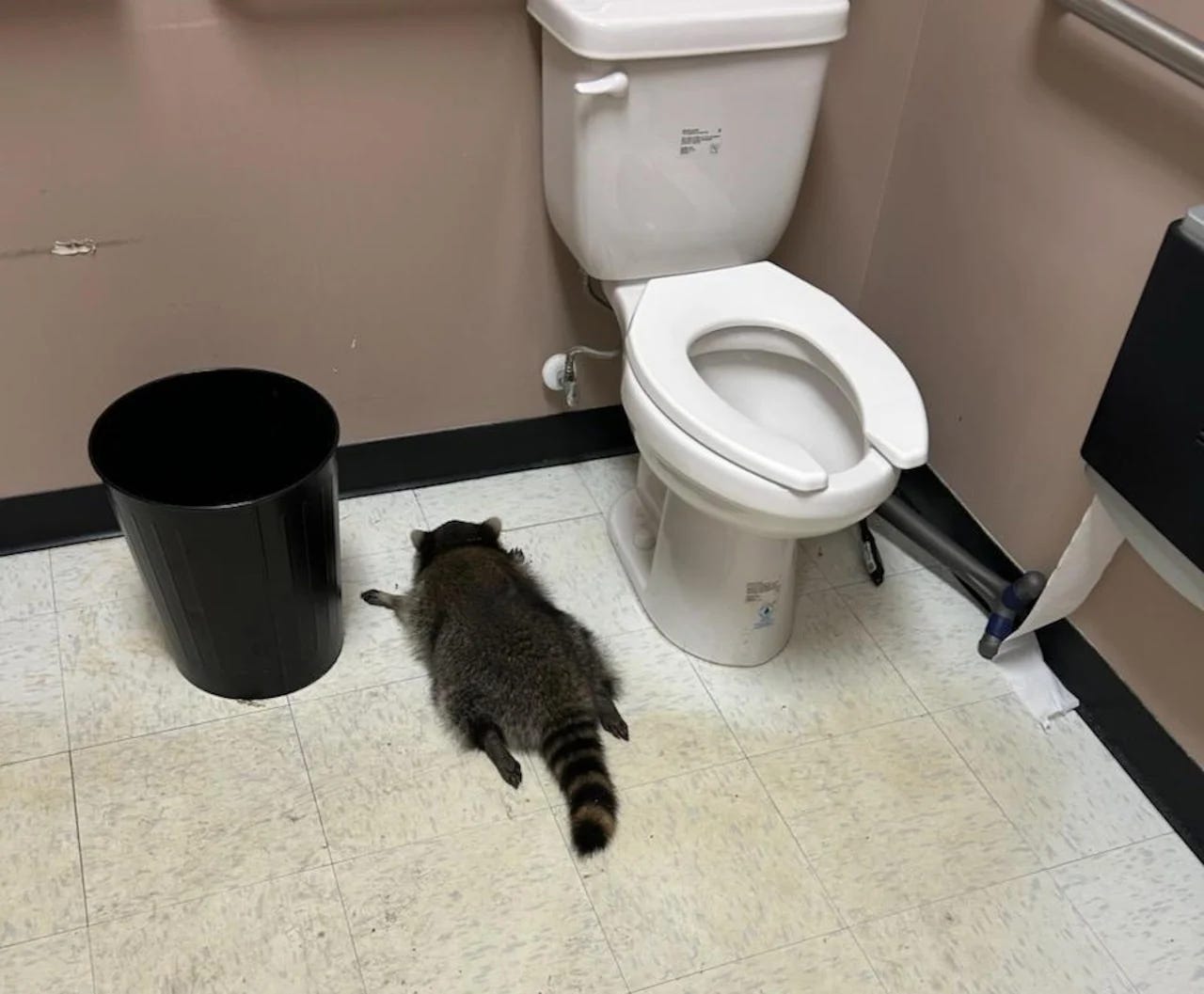
The biggest story of 2025, to judge from the number of people who sent it to me, was this raccoon:
In case you somehow missed this story: In late November, this raccoon got into a state liquor store in Ashland, Va., by falling though the ceiling. Once inside, the raccoon ransacked the store, leaving a trail of broken bottles…
FEBRUARY
…President Trump threatens to slap tariffs on goods from Mexico, Canada and China, all of which were originally built by Americans. Tariffs are taxes, so this would mean that the American consumer would pay more for these goods. To understand why this is a shrewd business tactic, consider an analogy: You’re in a dispute with your neighbor, Bob. So you go to Bob’s house and ring his doorbell. When he opens the door, you turn around and punch the American consumer in the face. Take that, Bob!
MARCH
On a happier note, two astronauts finally return to Earth after being stranded aboard the International Space Station for nine months. They say they’re “happy to be home,” but add “that’s the last time we’re booking on Spirit.”
MAY
On Memorial Day, a somber occasion when America honors its war dead, Trump posts a social-media message strongly reminiscent of the Gettysburg Address in its dignity and thoughtful eloquence. It begins (really): “HAPPY MEMORIAL DAY TO ALL, INCLUDING THE SCUM THAT SPENT THE LAST FOUR YEARS TRYING TO DESTROY OUR COUNTRY THROUGH WARPED RADICAL LEFT MINDS…”
…and so on for 109 thoughtful capitalized words, not one of which mentions our nation’s war dead, but you only have so much space on social media.
In 2025 the world produced record harvests of wheat, rice and soybeans for the third consecutive year, pushing grain prices down 8 percent and rice prices to their lowest in 18 years…
In September, The Lancet released a report with one of the most extraordinary statistics I’ve ever seen: since 2010, humanity’s total burden of illness and early death has dropped by 12.6 percent, driven by declining deaths from the world’s deadliest infectious diseases: tuberculosis, lower respiratory infections, diarrhoea, HIV/AIDS, all down by between 25 and 49 percent. This progress has been so dramatic that for the first time in our species’ history, lifestyle diseases (heart disease, cancer, diabetes) have displaced infectious illness as the dominant global threat. And here, mortality is falling too.
In 2025 the United States will almost certainly record its lowest murder rate in history. Not since the pandemic, not since the 1990s crime wave, but lower than any year since the FBI began tracking in 1960. Violent crime is at its lowest level since 1968. Property crime is at the lowest rate ever measured.
In August, the WHO and UNICEF released data showing that over the last decade 961 million people gained access to safe drinking water, 1.2 billion gained safe sanitation, and 1.5 billion gained basic hygiene services. Over the same period the number of people without electricity fell by 292 million, even as the global population grew by 760 million. According to the International Energy Agency, this represents the fastest expansion of electricity access in history.
Divide these numbers by ten to get the annual improvements. (For “access to safe drinking water,” that works out to 263,000 people per day.) Read the entire thing to feel better!



 Laugh / learn links log