Recording ICE safely

Tips on safely using your Constitutional rights to free speech in the face of authoritarian tactics. Summarized:

After Alex Pretti was fatally shot by an Immigration and Customs Enforcement (ICE) agent in Minneapolis, eyewitness cellphone videos became a powerful tool to contradict the Trump administration’s version of what had happened.

The Trump administration called Pretti “an assassin,” but videos show Pretti helping a protester who got pepper sprayed before he is pinned to the ground and shot. The Department of Homeland Security initially alleged in a statement that Pretti approached officers with a handgun, which is not supported by publicly available videos that show him clearly holding a cellphone when officers approached him.

People have the right to record law enforcement in public spaces under the First Amendment, but federal government officials have denounced people who do so. Last year, Department of Homeland Security Secretary Kristi Noem said that videotaping agents when they are out on operations is “violence.”

“There’s no guaranteed safe way to record ICE right now,” explained David Huerta, senior digital security trainer at Freedom of the Press Foundation. “There are ways to at least do so with as many safety measures as one could put in place.”

1. Before Filming, Prepare Yourself And Your Phone.

Burner phone, strong password, updated OS, and “Do this kind of activity with neighbors on your block or in pairs.”

2. While Filming, Narrate What You See For Verification Later.

“Make sure to mention the time, the date and an approximate location…” ((many details under the acronym “SALUTE”))

3. While Filming, Remember You’re There To Document.

Nathan-Pineau said she doesn’t encourage people to follow ICE officers back to their house.

4. While Filming, Ask The Person Being Arrested If They Want To Share Contact Info.

5. Focus Camera On Agents, Not People Being Detained.

If you do capture a person’s face, Nathan-Pineau advises against immediately sharing that video without obscuring the detained person’s face in some way.

6. Preserve Footage If Your Phone Gets Taken.

If you believe your phone is about to be seized by an officer, hit the stop button on the recording and turn the phone completely off. This “is probably the best protection, because then it’s in a fully encrypted state at that point,” Huerta said.

7. After Filming, Don’t Edit Your File.

(…)

After a federal agent fatally shot Renee Good in her car in Minnesota, Gov. Tim Walz asked residents to “carry your phone with you at all times” and “hit record” when they see ICE agents in neighborhoods.

“Help us create a database of the atrocities against Minnesotans, not just to establish a record for posterity, but to bank evidence for future prosecution,” he said.

1,800 words: https://www.huffpost.com/entry/how-to-record-ice-safety-tips_l_69811632e4b0926bfc4844ef. If you do this, read the entire article carefully.

Good news from Fix the News (info on dengue, AKA “breakbone disease” because of the great pain that some victims suffer):

Singapore demonstrates that specially-bred mosquitos can keep dengue suppressed at city-scale. Wolbachia is a bacterium that lives in many insects; when scientists breed male Aedes aegypti mosquitoes with it, those males don’t bite, and when they mate with wild females the eggs don’t hatch. In a 24 month trial across 15 residential areas in Singapore, this approach slashed wild female mosquitoes by around three‑quarters and reduced symptomatic dengue risk by roughly 70%. Medical Xpress

And an image from my collection:

America isn’t ready for what AI will do to jobs

Many economists insist that this will all be fine. Capitalism is resilient. The arrival of the ATM famously led to the employment of more bank tellers, just as the introduction of Excel swelled the ranks of accountants and Photoshop spiked demand for graphic designers. In each case, new tech automated old tasks, increased productivity, and created jobs with higher wages than anyone could have conceived of before. The BLS projects that employment will grow 3.1 percent over the next 10 years. That’s down from 13 percent in the previous decade, but 5 million new jobs in a country with a stable population is hardly catastrophic.

And yet: There are things that economists struggle to measure. Americans tend to derive meaning and identity from what they do. Most don’t want to do something else, even if they had any confidence—which they don’t—that they could find something else to do. Seventy-one percent of respondents to an August Reuters/Ipsos poll said they’re worried that artificial intelligence will “put too many people out of work permanently.”

A detailed account of what’s happened in the past, whether it will apply to this very different new technology, and what the numbers show (briefly, it’s too soon to tell)…

Acemoglu, who won the Nobel Prize in Economics in 2024, studies inequality; Autor focuses on labor. But both insist that the story of AI and its consequences will depend mostly on speed—not because they assume lost jobs will automatically be replaced, but because a slower rate of change leaves societies time to adapt, even if some of those jobs never come back.

7,600 words (yes, long, but covers a lot): https://www.theatlantic.com/magazine/2026/03/ai-economy-labor-market-transformation/685731/. If you cannot follow that link, try https://laughlearnlinks.home.blog/ai-and-jobs/.

Good news from Fix the News (and AI-related):

AI reads brain MRIs in seconds and flags emergencies. Researchers at the University of Michigan have developed an AI system that can analyse scans in seconds, identifying neurological conditions with up to 97.5% accuracy while also triaging urgency. Tested on over 30,000 MRI scans, the model flags strokes and haemorrhages for immediate attention, offering a potential fix for radiology backlogs and delayed diagnoses as MRI demand outpaces specialist capacity. Science Daily

And an image from my collection:

What to do if you have sleep apnea

In the past several years, CPAPs have become all the rage. (I use one myself.) It’s important to get sleep apnea treated, because it can lead to health problems:

Within a few years of starting CPAP, about 50% of patients use it too infrequently or stop completely. Left untreated, sleep apnea contributes to serious health issues including heart disease, strokes, and diabetes.

Some people have sleep apnea for different reasons:

Sometimes airways are obstructed at least partly due to certain facial and oral structures, like a recessed jaw or large tongue, that make it harder for CPAP alone to open the airway enough, even if the mask fits well, Motz says. Less common than obstructive sleep apnea is another form called central sleep apnea, in which breathing muscles aren’t active enough. For these patients, CPAP may not help as much. 

Ways to improve your CPAP usage? Often it’s getting a mask that fits properly:

Nose-only masks are generally most effective, but masks that extend over the mouth can benefit those who struggle with nasal breathing… Accessories can make CPAPs more usable, such as snug cushion covers and stands that hold the CPAP hose above the head and out of the way. A chin strap to keep the mouth closed is another strategy shown to improve tolerance for CPAP.

Another approach is working with a cognitive behavioral therapist to address insomnia symptoms, claustrophobia, or anxiety posed by CPAP.

Lifestyle behaviors can help right now. For many people, reducing weight through exercise and healthy nutrition is a powerful strategy to counter sleep apnea. “If your weight goes up, you’re fighting an uphill battle,” Motz says. Dropping 10-15% can reduce sleep apnea severity by about 50%.

Full article (approx 1,900 words): https://time.com/7176245/sleep-apnea-treatments-cpap-machine/.

Good news from Fix the News ((my exclamation)):

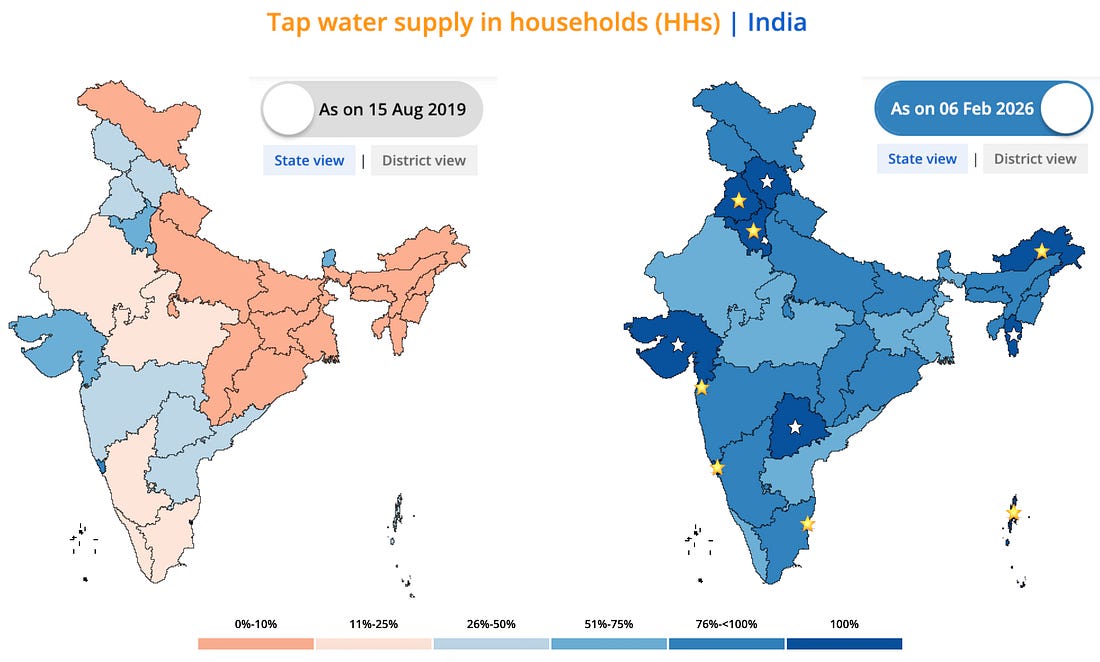
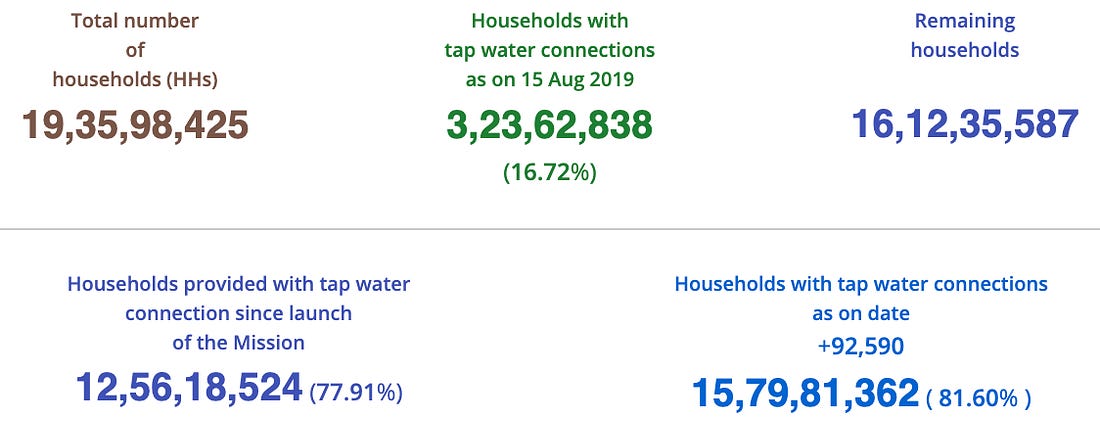
India has expanded rural tap water access from 16.7% of the population in 2019 to 81% in 2026 ((that’s seven years!))connecting 125 million rural households to clean, running water. In sheer numbers, this is the biggest, fastest, and most important sanitation drive in human history. Why has it not been more widely reported? PIB Delhi

And an image from my collection: