Excerpts (it’s worth reading the entire 4,500 words):
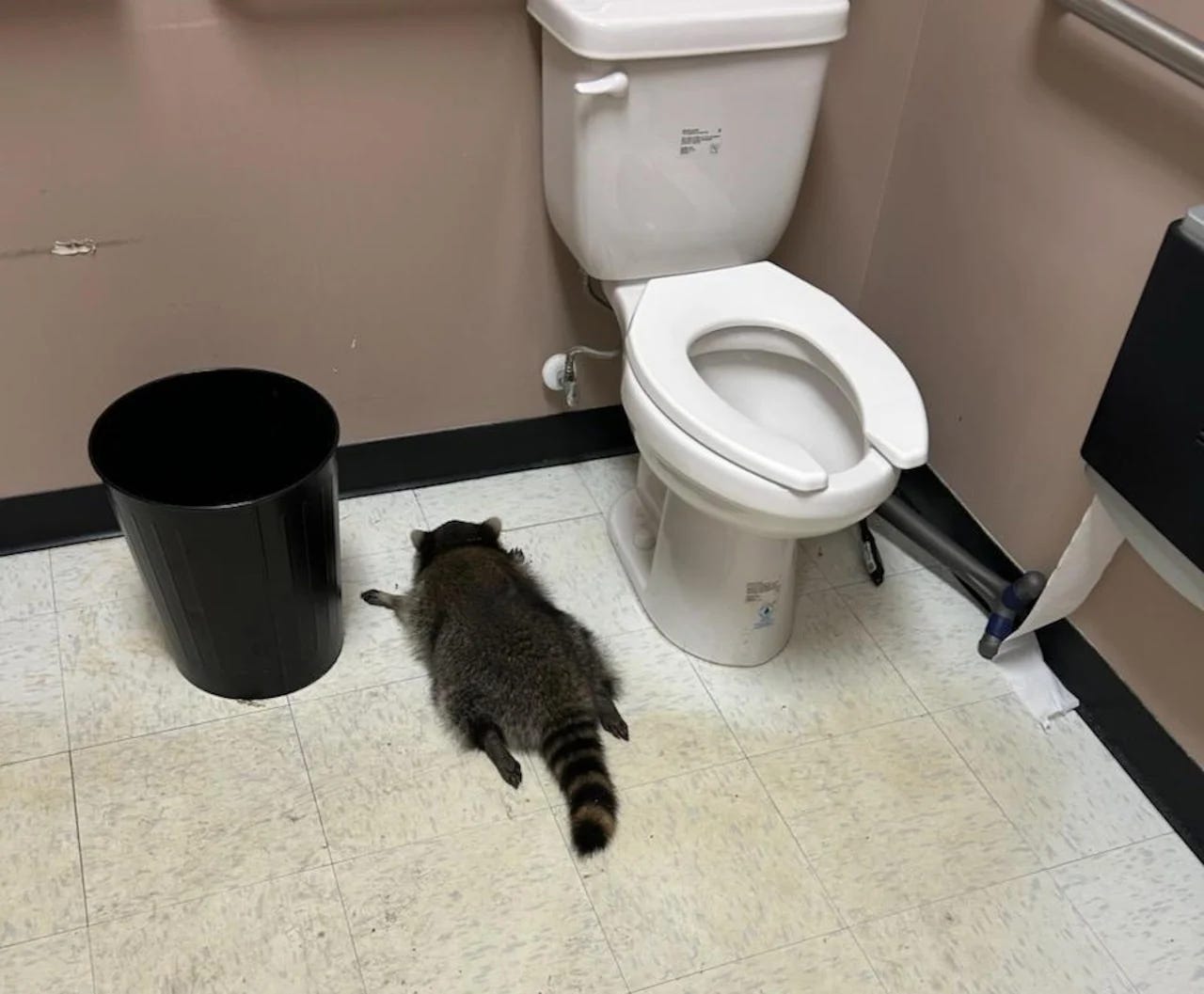
The biggest story of 2025, to judge from the number of people who sent it to me, was this raccoon:
In case you somehow missed this story: In late November, this raccoon got into a state liquor store in Ashland, Va., by falling though the ceiling. Once inside, the raccoon ransacked the store, leaving a trail of broken bottles…
FEBRUARY
…President Trump threatens to slap tariffs on goods from Mexico, Canada and China, all of which were originally built by Americans. Tariffs are taxes, so this would mean that the American consumer would pay more for these goods. To understand why this is a shrewd business tactic, consider an analogy: You’re in a dispute with your neighbor, Bob. So you go to Bob’s house and ring his doorbell. When he opens the door, you turn around and punch the American consumer in the face. Take that, Bob!
MARCH
On a happier note, two astronauts finally return to Earth after being stranded aboard the International Space Station for nine months. They say they’re “happy to be home,” but add “that’s the last time we’re booking on Spirit.”
MAY
On Memorial Day, a somber occasion when America honors its war dead, Trump posts a social-media message strongly reminiscent of the Gettysburg Address in its dignity and thoughtful eloquence. It begins (really): “HAPPY MEMORIAL DAY TO ALL, INCLUDING THE SCUM THAT SPENT THE LAST FOUR YEARS TRYING TO DESTROY OUR COUNTRY THROUGH WARPED RADICAL LEFT MINDS…”
…and so on for 109 thoughtful capitalized words, not one of which mentions our nation’s war dead, but you only have so much space on social media.
In 2025 the world produced record harvests of wheat, rice and soybeans for the third consecutive year, pushing grain prices down 8 percent and rice prices to their lowest in 18 years…
In September, The Lancet released a report with one of the most extraordinary statistics I’ve ever seen: since 2010, humanity’s total burden of illness and early death has dropped by 12.6 percent, driven by declining deaths from the world’s deadliest infectious diseases: tuberculosis, lower respiratory infections, diarrhoea, HIV/AIDS, all down by between 25 and 49 percent. This progress has been so dramatic that for the first time in our species’ history, lifestyle diseases (heart disease, cancer, diabetes) have displaced infectious illness as the dominant global threat. And here, mortality is falling too.
In 2025 the United States will almost certainly record its lowest murder rate in history. Not since the pandemic, not since the 1990s crime wave, but lower than any year since the FBI began tracking in 1960. Violent crime is at its lowest level since 1968. Property crime is at the lowest rate ever measured.
In August, the WHO and UNICEF released data showing that over the last decade 961 million people gained access to safe drinking water, 1.2 billion gained safe sanitation, and 1.5 billion gained basic hygiene services. Over the same period the number of people without electricity fell by 292 million, even as the global population grew by 760 million. According to the International Energy Agency, this represents the fastest expansion of electricity access in history.
Divide these numbers by ten to get the annual improvements. (For “access to safe drinking water,” that works out to 263,000 people per day.) Read the entire thing to feel better!
Change is hard because sometimes you need your discomfort to get huge before you will feel it’s bad enough to make a change or leave a situation. Maybe your tolerance for bullshit is a little too high.
The ole’ devil you know, so to speak.
But change is possible! Don’t forget to ask yourself, is this helping me?
Good news from Fix the News (previous week’s, they’re taking the rest of December off):
Wildlife rangers in southern Africa have plenty of experience in chasing off poachers — but often lack the tools to actually catch the culprits. Now parks in South Africa and Zimbabwe have started employing police dogs from Wales, with great success. Nonprofit Dogs4Wildlife, which provides the dogs, gives priority to smaller reserves, which have far fewer anti-poaching resources than Africa’s most renowned parks. “Some of the smaller wildlife reserves have almost eradicated poaching completely, just because of the deterrent value.” CNN
Civil-military relations (typically shortened to ‘civ-mil’) is the relationship between the broader civil society and its military. As you might well imagine, the nature of civil-military relations vary substantially based on institutions but are even more sensitive to norms, because institutional and legal structures can only restrain folks with arms to the degree that they collectively agree to be restrained.
In practice, American civ-mil is, in a sense, fundamentally based on a bargain, the foundations of which date to the American Revolution but which has evolved and solidified since then. That bargain has been remarkably successful: the United States has avoided the sort of major civ-mil disjunctures (like military coups) that are often distressingly common in many states and has done so for two and a half centuries. That isn’t to say the American civ-mil has been forever untroubled, as we’ll see: it is an evolving bargain, based on norms and thus fundamentally both precious and fragile….
It is hard not to view the second Trump administration as at least attempting to directly attack those norms in response. The president by habit refers to‘his military’ and ‘his generals,’ while his Secretary of Defense began his term as SecDef with an unprecedented string of political firings – Gen. CQ Brown Jr. (Chair of the Joint Chiefs), Gen. Timothy Haugh (CYBERCOM), Adm. Lisa Franchetti (Navy CNO), Adm. Linda Fagan (Coast Guard commandant); Gen. Charles Hamilton (Army Materiel Command) and Gen. Jim Slife (Vice Chief of Staff). That is not the sort of thing incoming administrations generally do, but it also seems worth noting, particularly in the context of Hegseth’s open rejection of gender and racial inclusivity in the military, that those high profile firings removed every woman and person of color from the Joint Chiefs. That military parade happened this time, on Trump’s birthday no less.
Good news from Fix the News (last week’s, they’re taking the rest of December off):
An 18-year-old in Alabama redrew their state’s senate map on free software, and a federal judge adopted it over plans drafted by professional cartographers, fixing a Voting Rights Act violation for nearly 300,000 people.
If you follow the link (to The Guardian), some of the details:
The decision stunned “DD” – an 18-year-old freshman at the University of Alabama named Daniel DiDonato – who learned his map had been selected as he was preparing to leave for his 9.30am introduction to political science class.
“I was absolutely surprised,” he said in an interview. “Now, nearly 300,000 Alabamians will be voting under new district lines that I drew up at two in the morning in a dorm, a cramped dorm study room.”
First, a definition from the article: “The term visual effects (VFX) is often mistakenly used interchangeably with CGI, but the two are distinct. VFX can include CGI, but it also includes other techniques such as matte painting, or compositing different images — sometimes computer-generated, sometimes live-action — together using blue or green screens.”
But seriously, what is AI even good for? Is this all just in aid of search summaries and ChatGPT girlfriends? Well, not entirely. Five years of AlphaFold has caused a global shift in how biology is done. Humanity now has a public database of 200 million predicted protein folds used by millions of researchers, faster pathways for drug design, and the tool has been cited in more than 35,000 papers. AI can now predict not just protein structures, but full molecular interactions, accelerating discovery far beyond what labs alone could achieve.
Cheaper and easier to build than manned vehicles, and in some cases more effective, drones are a military planner’s dream – and greatly reduce the risk of a pilot or operator being killed in action.
Nice little history of drones — the first one was flown in 1935, and “We were flying hundreds of drones over North Vietnam during the war.”
Drones came to the forefront of warfare relatively recently, some analysts say, with the 2020 conflict between Armenia and Azerbaijan in Nagorno-Karabakh a major turning point… In announcing its drone deal with Kyiv in June, the UK Defense Ministry said drone technology is evolving, on average, every six weeks.
Shepherd told CNN he’s seen drones go from paper sketches to deployment on the Ukrainian battlefield in a month… While the African drone market is largely import-driven – Turkey and China being the main sources – nine African countries are now producing indigenous drones, Allen wrote.
Artificial intelligence now gives some the on-board ability to identify targets, look for their weak points and execute an attack, all with split-second timing.
How to deal with them?
“The (Chinese) market now features more than 3,000 manufacturers producing anti-drone equipment in some form…
Learning to live with a problem is not a solution.
Mary Hamel described working in Kenya in the 1990s, when malaria had been so widespread, and so virulent, that children would die in line waiting to be seen. Now there were empty beds. Two stark, unforgettable images, and proof that something had shifted. What Scott had told us didn’t appear in any of the formal reports; it was anecdotal, fragile, early. But it was also proof that this entire effort – the decades of research, the logistics, the money, the faith – was actually saving lives.
Emergency room doctors see the worst-case scenarios, the weird fluke accidents, the mysterious ailments and miraculous recoveries. They’re also no strangers to the symptoms that patients didn’t take seriously until it was almost too late.
Here, ER docs share 10 red flags that patients often ignore—but which should be addressed urgently:
Sudden confusion or personality change
Sudden confusion or a personality change could indicate a stroke, an infection like sepsis, or low blood sugar, she adds, which is why it’s essential to seek immediate care at the ER.
Unusual upper back pain
Always pay attention to severe pain in your upper back or between your shoulder blades, especially if it comes on suddenly or is accompanied by other symptoms like nausea or dizziness. “Call 911. It could be a sign of a heart attack.” For some people—including women—heart attack pain shows up in surprising places, like the back, neck, or jaw.
Sudden, unexplained severe itching
If you can’t stop scratching—especially if you itch all over instead of in just one spot—you could be experiencing the beginning of an anaphylactic reaction. Even more alarming: if your symptoms are accompanied by nausea, vomiting, or diarrhea.
Vomit that’s a certain color
Bile, which is usually green, “can indicate a really dangerous obstruction in their intestines…” If your throw-up looks like coffee grounds—it’s dark brown or even black—it might include blood that’s been partially digested by stomach acids. Red vomit triggers even louder alarm bells, indicating “there’s quite a lot of blood moving.”
A sense of doom
When extreme anxiety strikes out of nowhere, take it seriously—especially if it’s accompanied by trouble breathing, a racing heart, or dizziness. It could be the body’s reaction to a heart attack or blood clot, or a severe allergic reaction. “If it’s new, intense, or feels different than usual anxiety, don’t ignore it.”
Randomly passing out
Fainting or almost fainting without a clear cause can be a red flag for abnormal heart rhythms, internal bleeding, or neurological issues. That said, it could also be the result of dehydration or standing up too fast.
White poop
If you’re having white bowel movements, it’s possible your bile tract could be obstructed, meaning bile—which contributes to the normal color of stool—isn’t reaching the intestines. “The scary thing that does that is pancreatic cancer.”
Urinary retention
There is one clear sign that constipation needs to be addressed urgently: you’ve stopped being able to pee. A full, impacted bowel “can cause bladder obstruction because, anatomically, it can press a lot in that pelvic region,” he says. “If somebody’s not urinating, that’s a big problem.” Not resolving the matter in a timely manner can ultimately lead to kidney failure.
Shortness of breath while lying down
Gasping for air when you’re horizontal could signal heart failure, a blood clot in the lungs, or a silent heart attack.
Leg pain or swelling in one leg
If you’re experiencing leg pain or swelling in just one leg, and if it’s also red, warm, or painful, you could have deep vein thrombosis, which requires urgent treatment. That blood clot could break loose and travel to your lungs, causing a pulmonary embolism, which can be fatal.
For over a century, Africa’s ‘meningitis belt’ stretching from Senegal to Ethiopia, has suffered deadly outbreaks every few years. Now, a breakthrough 13 years in the making could stop those outbreaks for good. Developed by the Serum Institute of India, the Men5CV vaccine protects against five major bacterial strains for just $3 a dose. It’s already rolling out in Niger and Nigeria, while Mali, Ghana, Burkina Faso, Chad and Togo all have plans to introduce it in the coming months. Telegraph
Some general advice for us non-experts on using ChatGPT and other AI assistants. (Note that the field is changing rapidly and will probably continue changing rapidly for at least several years…)
TIME spoke with five experts who use AI in their own work—from math to psychology to neuroscience—to distill advice on how to use these systems most effectively, without eroding critical thinking in the process. Brief summaries:
Experiment for fit AI systems’ performance can be uneven and unpredictable. They can excel on complex tasks while struggling with simple ones. And the boundaries of what they are or aren’t good for are changing all the time…. To know which model is best for your needs, you need to spend at least a few hours playing with it. Understand their strengths AI systems perform better if you provide them with relevant information about yourself and whatever task you’re trying to complete. “I upload all my notes and documents, and it provides me with feedback that makes sense based on how I think, and on ideas I’ve had in the past,” says Anne-Laure Le Cunff, a neuroscientist at King’s College London…. Keep your brain in the loop actively collaborate with the AI, rather than blindly relying on its outputs. She uses AI as a thinking and conversational partner to improve her work—asking it to point out any blind spots or biases in her thinking, or key points she might have missed—rather than having it create material from scratch…. Consider them imaginary friends “All the evidence we have suggests [AI systems] work best when you treat them like people, even though they’re not people,” says Mollick. This looks like asking follow-up questions, pointing out when a system has made mistakes, and pushing back when you disagree with something. Every response gives the system more context, improving its response…. Set personal boundaries “We’re going to have to figure out what we think is too intimate or too sacred for the AI,” says Mollick. “I think it’s an important human decision we get to make. I don’t know where that line’s gonna end up being.” His personal line: he does all his writing himself first, before consulting AI, and he never uses it to grade student papers….
Overfishing has been almost entirely stopped in the territorial waters of the United States. An unlikely alliance of fishermen and environmentalists has ended competitive fishing and aligned profits with conservation. NOAA reports 50 stocks rebuilt since 2000, with 94% of assessed stocks not subject to overfishing today.USA Today
And an image from my collection:
(This is from http://xkcd.com. New cartoon three times a week, and always mouse over it to see extra text. In this case: “And if you labeled your axes, I could tell you EXACTLY how much better.”)
I was working in the lab late one night when my eyes beheld an eerie sight. Preventable diseases were on the rise and suddenly, to my surprise They did the slash — the monster slash! The budget slash — and our missions were scrapped. The science slash — turned our research to ash. They did the slash — they did the monster slash!
Scientists have used artificial intelligence to create an enzyme that can eat one of the toughest plastics on Earth: the kind used in foam mattresses and sneakers. The enzyme breaks polyurethane down into reusable chemicals in just 12 hours at 50°C, turning it back into raw materials. Truly circular recycling. Wild. We know it’s already in the headline, but did we mention they used AI to design this thing? Ars Technica
The lifetime risk of developing dementia after age 55 is estimated at 42 percent, according to a 2025 study of over 15,000 participants. The number of Americans developing dementia each year is estimated to increase from 514,000 in 2020 to about 1 million by 2060.
But there have been exciting strides in the diagnosis and treatments for Alzheimer’s, which accounts for 60 to 80 percent of dementia cases… About half of dementia cases may be preventable by addressing known risk factors, according to a 2024 Lancet Commission report.
We’ve been studying this for decades, and we’re finally getting some results:
An Alzheimer’s blood test: In May, the Food and Drug Administration approved the first blood test to detect signals of amyloid beta plaques and tau tangles — the biological hallmarks of Alzheimer’s disease — with over 90 percent accuracy.
Lifestyle interventions can lead to better cognition: Simultaneously targeting multiple areas — nutrition, exercise, cognitive training, health monitoring — improved cognitive measures of participants who were at risk of dementia.
Increasing focus on inflammation: Scientists are increasingly investigating the role played by inflammation in increasing dementia risk. “Alzheimer’s is a complex disease, and it’s likely not going to be a single approach.”
Vaccines may reduce dementia risk:One study published in Nature tracked more than 280,000 adults in Wales and found that the shingles vaccine cut the risk of developing dementia by 20 percent over a seven-year period.
A newly discovered link to lithium (in mice): Small amounts of lithium orotate could reverse the disease and restore brain function, which points to an exciting potential therapy.
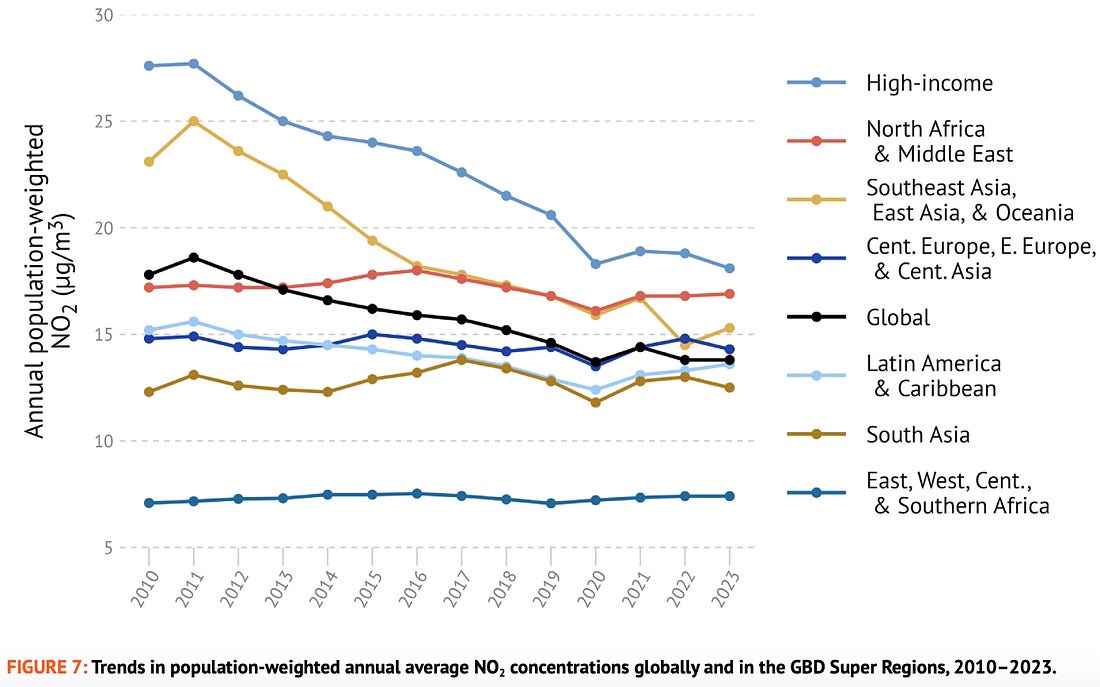
Global air-pollution deaths fall as clean-air era begins. For the first time in centuries, global deaths from air pollution are falling; down by 21% between 2013 and 2023 thanks to a steep drop in household smoke as billions gained access to cleaner cooking. The last 18 months have seen the fastest tightening of air-quality laws in history, and several major economies – notably China, the US and the EU – are now decoupling pollution from growth. State of Global Air 2025
The biggest citizen rally since the Vietnam War. I’ve seen estimates from five million to eight million people, in every state in the US (and a few rallies in other countries too). Two lists of signs:
Hey, Mr. Tangerine Man, stay away from me You are creepy, and you are no good for anything Hey, Mr. Tangerine Man, stay away from me You’re a traitor to our nation ’cause you act like a king…
Russia’s fossil-fuelled death machine is in trouble. Both the United States and the United Kingdom have just blacklisted Rosneft and Lukoil, Russia’s two largest oil companies, striking at the heart of war funding, while Taiwan will stop buying Russian naphtha after scrutiny of surging imports. Meanwhile, Russian coal miners posted massive losses in the first half of the year, with 23 companies shutting down and 53 at risk as prices slump and logistics bite, and in Europe, ministers have agreed to end Russian gas contracts by 2028, further cutting Moscow’s leverage.
Want to drill down into the specifics of how Russia’s being replaced? Take a look at Georgeta Carasiucenco and Peter Yeung’s excellent reporting of how Moldova turned the Russian gas crisis into a green energy revolution. When Russia’s invasion of Ukraine cut off supplies, Moldova’s villages raced to produce their own power…and now in Volintiri solar panels line schools and homes, and biomass has replaced gas, halving bills and boosting resilience. Nationally, renewables jumped from 3% to 25% of energy in just four years. Another win for green hero Vladimir Putin!
No image from my collection this week, the above should be plenty.





 Laugh / learn links log