“A handful of global oligarchs with extreme wealth have bought up our democracies; taken over our governments; gagged the freedom of our media; placed a stranglehold on technology and innovation; deepened poverty and social exclusion; and accelerated the breakdown of our planet,” (the open letter to the World Economic Forum in Davos) reads. “What we treasure, rich and poor alike, is being eaten away by those intent on growing the gulf between their vast power and everyone else.
“We all know this. When even millionaires, like us, recognise that extreme wealth has cost everyone else everything else, there can be no doubt that society is dangerously teetering off the edge of a precipice.”
Poland moves to recognise same-sex couples. Poland’s government has approved a bill introducing “cohabitation contracts” for couples living together regardless of gender – its first nationwide legal recognition of queer relationships. The bill, which covers health, housing and tax rights, stops short of marriage, but activists say it’s the only one with a real shot of passing in the current parliament. Reuter
Whatever you say about LLMs or AI today will shortly be obsolete:
“Just like Moore’s Law, we saw the doubling in performance every 18 months with AI. We have now started to see that doubling every six months or so,” said Satya Nadella, CEO of Microsoft at the company’s annual Ignite conference in 2024…. One (consequence) is that we are quickly approaching a world in which AI agents can autonomously produce scientific advancements. AI is already being used in fields like biotech… The other development is “agentic AI” that can execute increasingly complex workplace tasks without human intervention. This advancement, which experts say is probably a year away, will reinvent the workplace. Productivity will surge, the nature of white-collar work, and the number of white-collar workers, will change significantly.
Unfortunately, the current U.S. government has embarked on political and policy strategies that will inflict lasting self-harm. Its attacks on American universities will increasingly leave the nation with less scientific funding, broken public-private sector relationships, and much less ability to attract the most ambitious, talented, and highly skilled international students and immigrant labor.
In short, AI will have transformative effects on the domestic politics of every country where it is deployed at scale in the workforce. It will intensify the already contentious rivalry between Washington and Beijing—with direct implications for dozens of other countries. The need to think through the implications is urgent. This train is already in motion and beginning to gather speed.
If there is any field in which the rise of AI is already said to be rendering humans obsolete—in which the dawn of superintelligence is already upon us—it is coding. This makes the results of a recent study genuinely astonishing….
When researchers at MIT recently tracked the results of 300 publicly disclosed AI initiatives, they found that 95 percent of projects failed to deliver any boost to profits. A March report from McKinsey & Company found that 71 percent of companies reported using generative AI, and more than 80 percent of them reported that the technology had no “tangible impact” on earnings…
Every new technology experiences a “productivity J-curve”: At first, businesses struggle to deploy it, causing productivity to fall. Eventually, however, they learn to integrate it, and productivity soars. The canonical example is electricity, which became available in the 1880s but didn’t begin to generate big productivity gains for firms until Henry Ford reimagined factory production in the 1910s.
And good news from Fix the News (also in Time magazine: link, however this has not yet been peer reviewed):
Doctors say Huntington’s has been successfully treated for the first time, with gene therapy slowing decline by 75% in a 29-patient trial. The one-off treatment, delivered by 12–18 hours of brain surgery, reduced toxic protein levels and preserved neurons. Patients regained function, with some returning to work. Researchers call the results “spectacular,” offering decades of added quality life. BBC
According to textbook economics, the stock market’s value reflects what are known as “fundamentals.” An individual company’s current stock price is derived from that firm’s future-earnings potential, and is thus rooted in hard indicators such as profits and market share…
The fundamentals story held up well until the 2008 financial crisis. Within six months of the U.S. banking system’s collapse, the market fell by 46 percent. In response, the Federal Reserve cut interest rates to almost zero and pushed money back into the economy by purchasing trillions of dollars in securities from financial institutions… For most of the 2010s, corporate earnings were modest, GDP and productivity growth were low, and the labor market remained weaker than it had been before the crisis. In other words, the fundamentals were not great. Yet the stock market soared. From 2010 to 2019, it tripled in value.
More than half of the S&P 500’s total growth in 2023 and 2024 was driven by the so-called Magnificent Seven companies: Apple, Amazon, Alphabet, Meta, Microsoft, Tesla, and Nvidia. During those two years alone, Tesla’s value rose by 286 percent, Meta’s by 355 percent, and Nvidia’s by 861 percent. The biggest firms have always been responsible for a disproportionate share of the market’s growth, but never had the gains been so acutely concentrated.
So what the heck is going on?
Thanks to a series of regulatory changes in the late 2000s and early 2010s, about half of fund assets are now held in “passive funds.”… The most common type of passive fund purchases a tiny share of every single stock in an index, such as the S&P 500, proportional to its size.
We have a positive feedback loop here, friends. “Positive” does not mean “good,” it means “self-reinforcing.” A negative feedback loop tends to suppress its own growth: for example, a thermostat raises the heat if the temperature is too low, or raises the A/C if the temperature is too high. An example of a positive feedback loop is a microphone that’s too close to the speakers: it picks up music or speech, plus the sound from the speakers, and feeds that to the speakers, which get louder, and repeat until screech. Unregulated positive feedback loops always end in disaster.
As the “Magnificent Seven” become larger parts of the Fortune 500, passive funds buy more. Which makes the Seven larger, so passive funds buy more. Repeat until… well, I don’t know what will happen. But it will probably be unpleasant.
And good news from Fix the News: Sometimes no news really is good news!
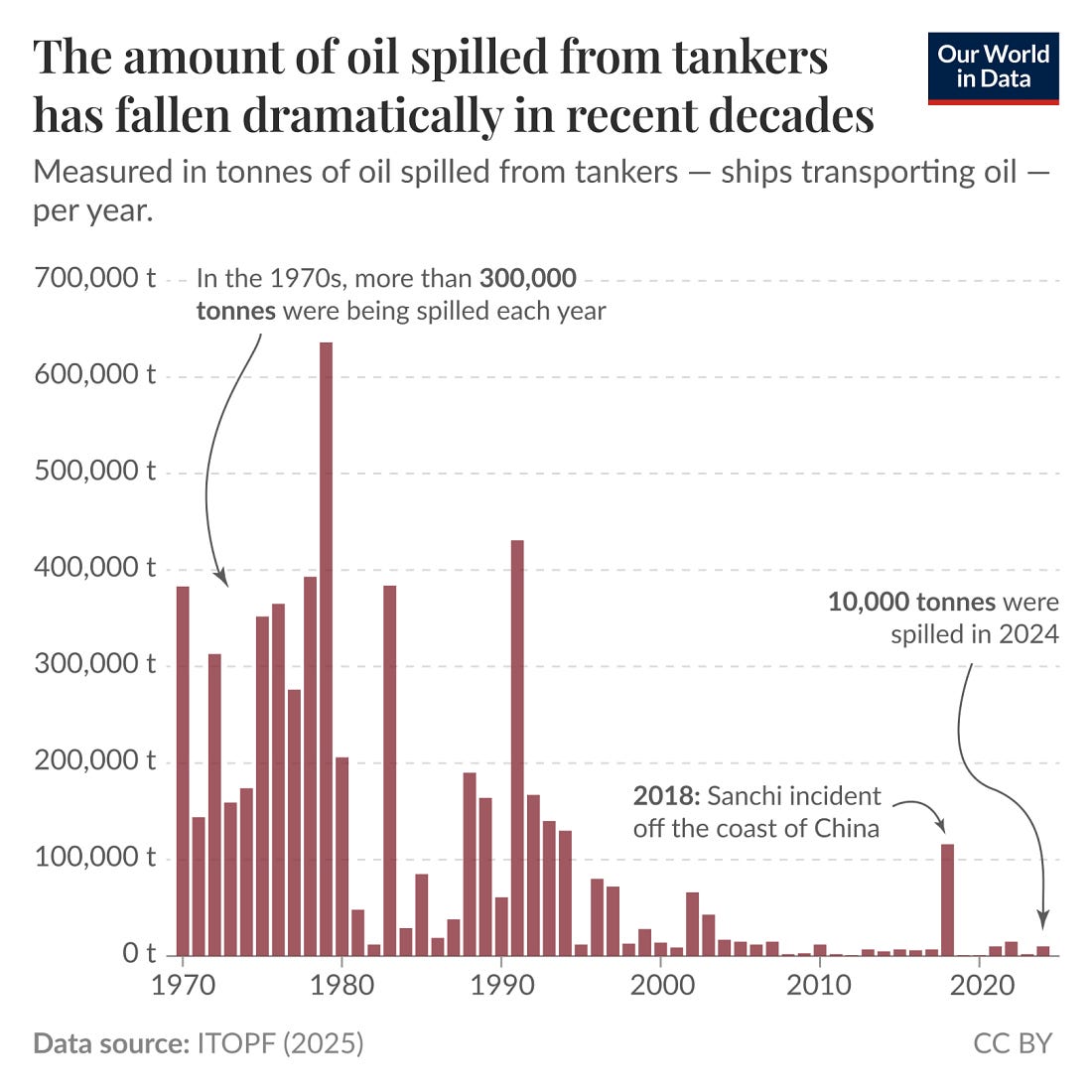
Oil tanker spills have nearly vanished since the 1970s. Half a century ago, spills released an average of 314,000 tonnes of oil into the ocean each year. However, better ship design, stricter regulation, and faster response capacity have turned once-routine disasters into rare events; today, the figure is below 10,000, less than one-thirtieth of its former level.Our World in Data