One thing I ask of you (Okay) Time to learn your homophones is past due (Woo) Learn to diagram a sentence, too Always say “to whom”, don’t ever say “to who” (Woo) And listen up when I tell you this I hope you never use quotation marks for emphasis (Woo)
Adult smoking in the United States has dropped below 10% for the first time. New analysis of national survey data found that cigarette use fell from 10.8% of adults in 2023 to 9.9% in 2024 (about 25 million people) down from 42% in 1964. The shift has helped drive a long fall in cancer mortality, with the American Cancer Society estimating reduced smoking prevented nearly four million lung cancer deaths between 1970 and 2022. Gizmodo
Plus an image from my collection, in honor of (recently) St. Patrick’s Day:
Sweden cuts shootings by 63% after policing overhaul. Gun violence in Sweden has dropped sharply since peaking in 2022, with shooting incidents falling to 147 in 2025, down from the 390 recorded three years earlier. Authorities attribute the shift to expanded surveillance powers, tougher sentencing and new police tactics targeting criminal networks, which have also improved asset seizures and disruption of gang operations. Reuters
If it’s possible in Sweden (in just three years), maybe it’s possible here…
And an image from my collection. People’s profile pictures on dating sites often include other people; for privacy, many people will “scratch out” the faces of the others:
The website NotAlwaysRight.com has listed its 25 highest-rated inspirational stories of 2025: small interactions with people that turned out really nice. Some of the titles:
Bogotá’s care blocks are buying women their time back. Colombia’s capital is home to eight million people, and 1.2 million women who do more than ten hours a day of unpaid care. Since 2020 though, the city has opened 25 neighbourhood hubs where caregivers can drop off children or elderly relatives, do the laundry, then use free legal aid, training or mental-health support – or just sit down and read a book. The model is now spreading to Sierra Leone, Mexico and (soon) the United States. Vox
Make me walk, make me talk, do whatever you please I can act like a star, I can beg on my knees Come jump in, bimbo friend, let us do it again.
Mattel (Barbie’s owner) responded by suing in 1997 for trademark and copyright violations; Aqua and MCA denied the charges, and countersued for defamation after Mattel compared MCA to bank robbers.
Ultimately all the cases were dismissed in 2002; the song was ruled to be a legal parody. (The judgment does thoroughly cover the applicable law and precedents.) Apparently, though, the judge had some opinions about the case:
OPINION
KOZINSKI, Circuit Judge:
If this were a sci-fi melodrama, it might be called Speech-Zilla meets Trademark Kong. … With fame often comes unwanted attention. Aqua is a Danish band that has, as yet, only dreamed of attaining Barbie-like status. In 1997, Aqua produced the song Barbie Girl on the album Aquarium.
And in particular (bolding is mine):
An MCA spokeswoman noted that each album included a disclaimer saying that Barbie Girl was a “social commentary [that was] not created or approved by the makers of the doll,” a Mattel representative responded by saying, “That’s unacceptable…. It’s akin to a bank robber handing a note of apology to a teller during a heist. [It n]either diminishes the severity of the crime, nor does it make it legal.” He later characterized the song as a “theft” of “another company’s property.”
MCA filed a counterclaim for defamation based on the Mattel representative’s use of the words “bank robber,” “heist,” “crime” and “theft.” But all of these are variants of the invective most often hurled at accused infringers, namely “piracy.” No one hearing this accusation understands intellectual property owners to be saying that infringers are nautical cutthroats with eyepatches and peg legs who board galleons to plunder cargo. In context, all these terms are nonactionable “rhetorical hyperbole,” Gilbrook v. City of Westminster, 177 F.3d 839, 863 (9th Cir.1999). The parties are advised to chill.
Excerpts (it’s worth reading the entire 4,500 words):
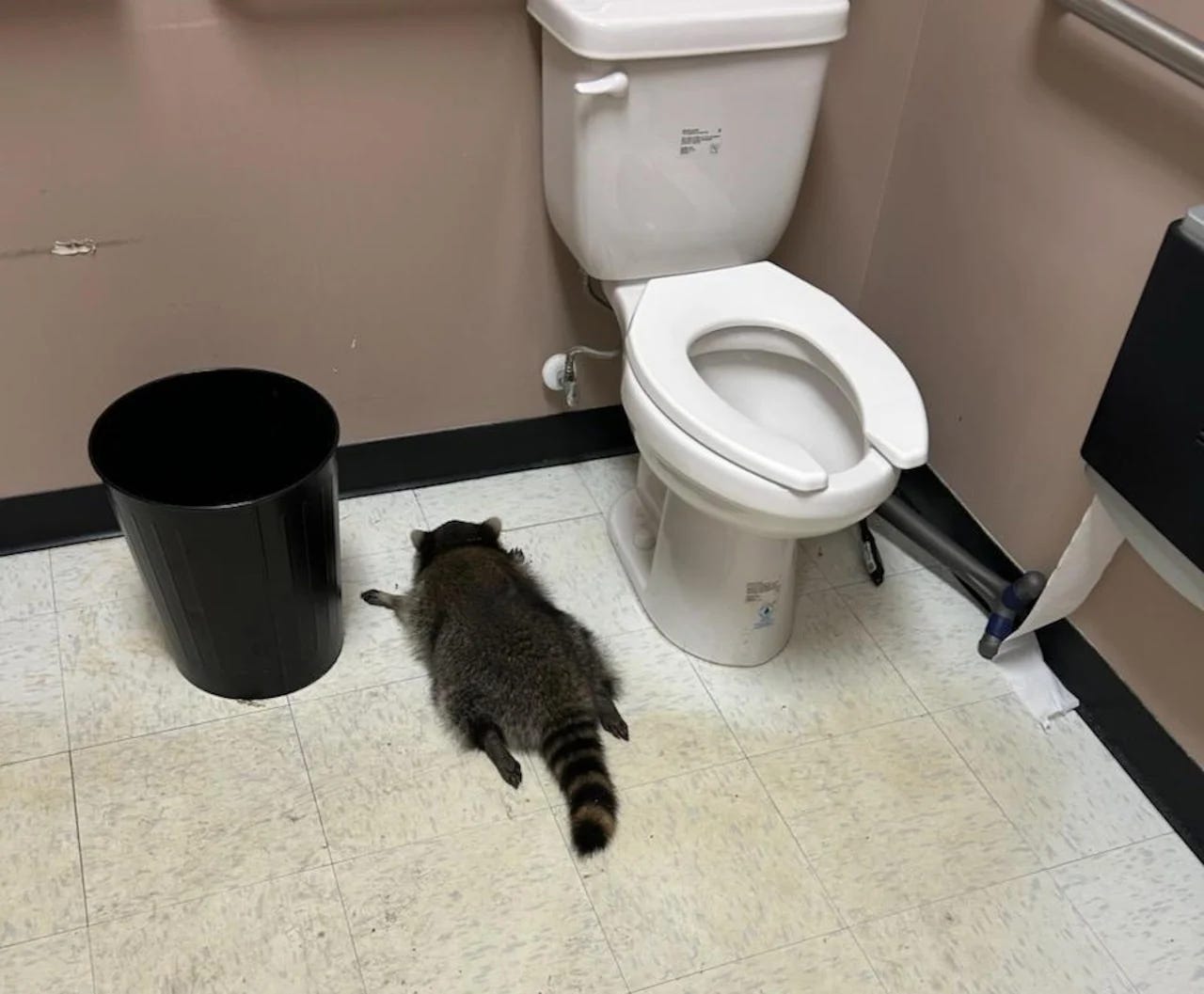
The biggest story of 2025, to judge from the number of people who sent it to me, was this raccoon:
In case you somehow missed this story: In late November, this raccoon got into a state liquor store in Ashland, Va., by falling though the ceiling. Once inside, the raccoon ransacked the store, leaving a trail of broken bottles…
FEBRUARY
…President Trump threatens to slap tariffs on goods from Mexico, Canada and China, all of which were originally built by Americans. Tariffs are taxes, so this would mean that the American consumer would pay more for these goods. To understand why this is a shrewd business tactic, consider an analogy: You’re in a dispute with your neighbor, Bob. So you go to Bob’s house and ring his doorbell. When he opens the door, you turn around and punch the American consumer in the face. Take that, Bob!
MARCH
On a happier note, two astronauts finally return to Earth after being stranded aboard the International Space Station for nine months. They say they’re “happy to be home,” but add “that’s the last time we’re booking on Spirit.”
MAY
On Memorial Day, a somber occasion when America honors its war dead, Trump posts a social-media message strongly reminiscent of the Gettysburg Address in its dignity and thoughtful eloquence. It begins (really): “HAPPY MEMORIAL DAY TO ALL, INCLUDING THE SCUM THAT SPENT THE LAST FOUR YEARS TRYING TO DESTROY OUR COUNTRY THROUGH WARPED RADICAL LEFT MINDS…”
…and so on for 109 thoughtful capitalized words, not one of which mentions our nation’s war dead, but you only have so much space on social media.
In 2025 the world produced record harvests of wheat, rice and soybeans for the third consecutive year, pushing grain prices down 8 percent and rice prices to their lowest in 18 years…
In September, The Lancet released a report with one of the most extraordinary statistics I’ve ever seen: since 2010, humanity’s total burden of illness and early death has dropped by 12.6 percent, driven by declining deaths from the world’s deadliest infectious diseases: tuberculosis, lower respiratory infections, diarrhoea, HIV/AIDS, all down by between 25 and 49 percent. This progress has been so dramatic that for the first time in our species’ history, lifestyle diseases (heart disease, cancer, diabetes) have displaced infectious illness as the dominant global threat. And here, mortality is falling too.
In 2025 the United States will almost certainly record its lowest murder rate in history. Not since the pandemic, not since the 1990s crime wave, but lower than any year since the FBI began tracking in 1960. Violent crime is at its lowest level since 1968. Property crime is at the lowest rate ever measured.
In August, the WHO and UNICEF released data showing that over the last decade 961 million people gained access to safe drinking water, 1.2 billion gained safe sanitation, and 1.5 billion gained basic hygiene services. Over the same period the number of people without electricity fell by 292 million, even as the global population grew by 760 million. According to the International Energy Agency, this represents the fastest expansion of electricity access in history.
Divide these numbers by ten to get the annual improvements. (For “access to safe drinking water,” that works out to 263,000 people per day.) Read the entire thing to feel better!
Change is hard because sometimes you need your discomfort to get huge before you will feel it’s bad enough to make a change or leave a situation. Maybe your tolerance for bullshit is a little too high.
The ole’ devil you know, so to speak.
But change is possible! Don’t forget to ask yourself, is this helping me?
Good news from Fix the News (previous week’s, they’re taking the rest of December off):
Wildlife rangers in southern Africa have plenty of experience in chasing off poachers — but often lack the tools to actually catch the culprits. Now parks in South Africa and Zimbabwe have started employing police dogs from Wales, with great success. Nonprofit Dogs4Wildlife, which provides the dogs, gives priority to smaller reserves, which have far fewer anti-poaching resources than Africa’s most renowned parks. “Some of the smaller wildlife reserves have almost eradicated poaching completely, just because of the deterrent value.” CNN
I was working in the lab late one night when my eyes beheld an eerie sight. Preventable diseases were on the rise and suddenly, to my surprise They did the slash — the monster slash! The budget slash — and our missions were scrapped. The science slash — turned our research to ash. They did the slash — they did the monster slash!
Scientists have used artificial intelligence to create an enzyme that can eat one of the toughest plastics on Earth: the kind used in foam mattresses and sneakers. The enzyme breaks polyurethane down into reusable chemicals in just 12 hours at 50°C, turning it back into raw materials. Truly circular recycling. Wild. We know it’s already in the headline, but did we mention they used AI to design this thing? Ars Technica
Swimmers dive into Chicago river after 98 years. Some 300 swimmers looped through downtown Chicago in the first official river swim since 1927, a milestone made possible by decades of cleanup, starting with the creation of the Environmental Protection Agency and Clean Water Act in the 1970s. Volunteers and new infrastructure revived the waterway, luring back fish, beavers, and even ‘Chonkosaurus,’ a giant snapping turtle. The Guardian
Ebola outbreak in the DRC met with absolutely off-the-charts public health capacity. The DRC just confirmed a new outbreak of Ebola, BUTin under 24 hours, the virus was isolated, sequenced and the sequence data made publicly available. Genuinely incredible to see this kind of resolution and turnaround go from sci-fi to feasible over the course of the last decade. Wow.
And for some reason, this picture is just super funny to me:
Something light and easy this week: “In Somerville, Massachusetts, a community bike path has, in recent months, become a hotly contested political constituency.”
US prison population falls to its lowest in decades. America’s prison population has declined to its lowest level since 1992, with around 1.2 million people behind bars, down from a 2009 peak of 1.6 million. The shift reflects sentencing reforms, drug decriminalisation, diversion to treatment, and falling violent crime. The Atlantic




 Laugh / learn links log