The American civil-military relationship

A long one this time (8,000 words) but an impressive review of how civilian governments (presumably, the implementers of the public will) interact with the government’s military (who have more guns than everyone else put together). https://acoup.blog/2025/07/04/collections-the-american-civil-military-relationship/:

Civil-military relations (typically shortened to ‘civ-mil’) is the relationship between the broader civil society and its military. As you might well imagine, the nature of civil-military relations vary substantially based on institutions but are even more sensitive to norms, because institutional and legal structures can only restrain folks with arms to the degree that they collectively agree to be restrained.

In practice, American civ-mil is, in a sense, fundamentally based on a bargain, the foundations of which date to the American Revolution but which has evolved and solidified since then. That bargain has been remarkably successful: the United States has avoided the sort of major civ-mil disjunctures (like military coups) that are often distressingly common in many states and has done so for two and a half centuries. That isn’t to say the American civ-mil has been forever untroubled, as we’ll see: it is an evolving bargain, based on norms and thus fundamentally both precious and fragile….

It is hard not to view the second Trump administration as at least attempting to directly attack those norms in response. The president by habit refers to ‘his military’ and ‘his generals,’ while his Secretary of Defense began his term as SecDef with an unprecedented string of political firings – Gen. CQ Brown Jr. (Chair of the Joint Chiefs), Gen. Timothy Haugh (CYBERCOM), Adm. Lisa Franchetti (Navy CNO), Adm. Linda Fagan (Coast Guard commandant); Gen. Charles Hamilton (Army Materiel Command) and Gen. Jim Slife (Vice Chief of Staff). That is not the sort of thing incoming administrations generally do, but it also seems worth noting, particularly in the context of Hegseth’s open rejection of gender and racial inclusivity in the military, that those high profile firings removed every woman and person of color from the Joint Chiefs. That military parade happened this time, on Trump’s birthday no less.

Good news from Fix the News (last week’s, they’re taking the rest of December off):

An 18-year-old in Alabama redrew their state’s senate map on free software, and a federal judge adopted it over plans drafted by professional cartographers, fixing a Voting Rights Act violation for nearly 300,000 people.

If you follow the link (to The Guardian), some of the details:

The decision stunned “DD” – an 18-year-old freshman at the University of Alabama named Daniel DiDonato – who learned his map had been selected as he was preparing to leave for his 9.30am introduction to political science class.

“I was absolutely surprised,” he said in an interview. “N​​ow, nearly 300,000 Alabamians will be voting under new district lines that I drew up at two in the morning in a dorm, a cramped dorm study room.”

And an image from my collection:

Are we better off than we were a millennium ago?

In my opinion, we’re living in a Golden Age, especially regarding healthcare. But these numbers are pretty astounding: global GDP in the year 1 was around $248 billion, in 1001 around $285 billion (up about 15%), in 1993 around $62 trillion (up around 24,876%). It’s routine to build massive civilian infrastructure: roads, hospitals, schools, bridges, and not just out of wood or stone anymore…

Here’s one article with a graph: https://ourworldindata.org/grapher/global-gdp-over-the-long-run:

This article has some more detail: https://www.visualcapitalist.com/mapped-gdp-per-capita-worldwide/: “In 1990, 1.9 billion people lived in extreme poverty, which was 36% of the world’s population at the time. Over the last 30 years, the number has been steadily decreasing — by 2030, an estimated 479 million people will be living in extreme poverty, which according to UN population estimates, will represent only 6% of the population.”

This is a growth rate of world GDP of 87% in the 120 years 1700-1820; 311% in another hundred years from 1820-1920; and 2,390% in 103 years from 1920-2023. What will just the next 25 years present to us?

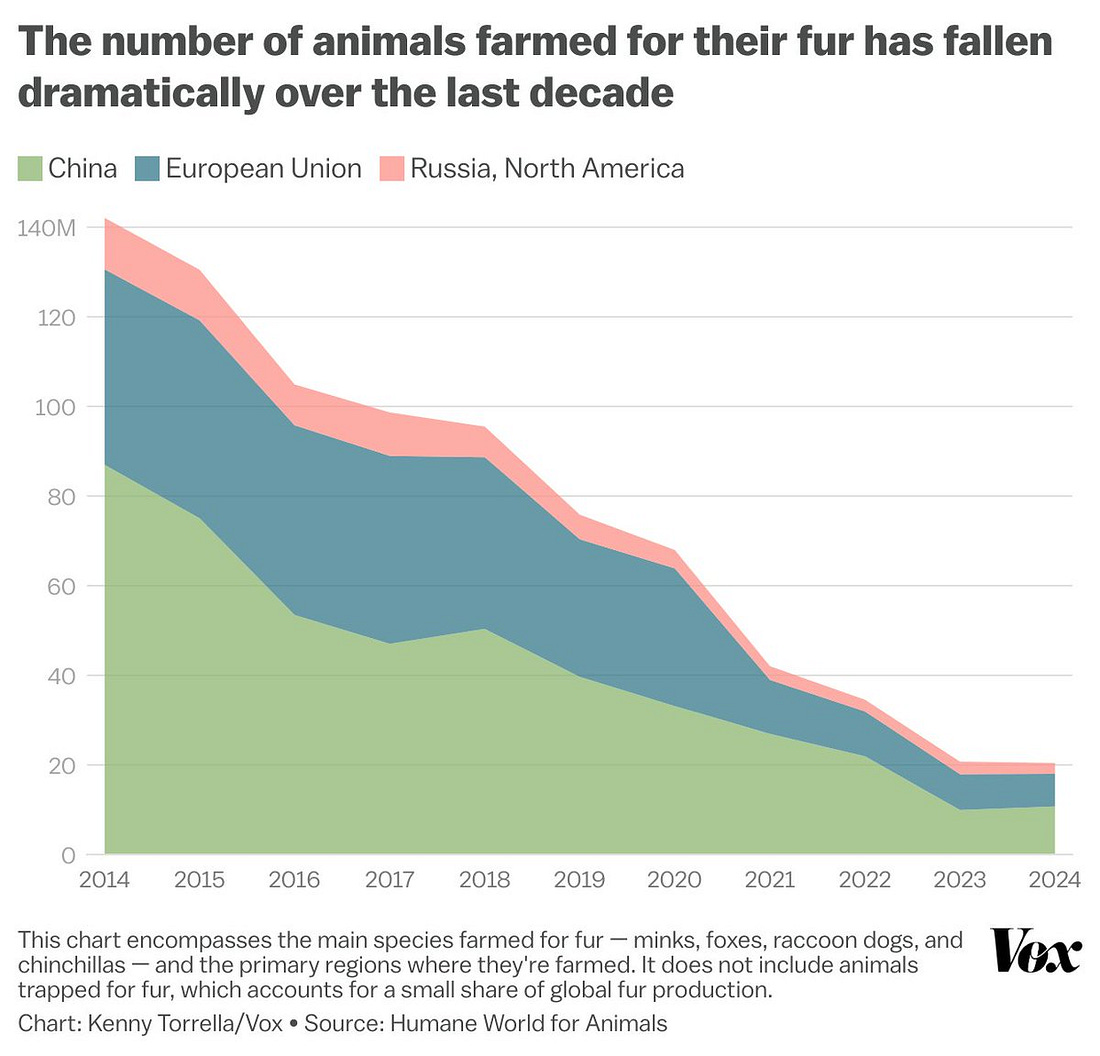
And good news from Fix the News:

Check out fur’s fall from grace: a $40 billion industry gutted in a decade. In 2014, fur farms killed over 140 million animals. By 2024, that number was down to 20.5 million. The collapse came fast: Gucci’s 2017 fur-free pledge set off a luxury brand exodus, COVID-19 outbreaks on mink farms shut down operations across Europe, and sanctions and crackdowns hit demand in Russia and China. Vox says it’s the greatest animal welfare victory of the 21st century.

Steven Rouk (@stevenrouk) / X

And an image from my collection:

World’s richest 1% increased wealth by $33.9 trillion

…since 2015 (one decade). Yes, that’s “trillion” with a “T.” $33,900 billion. $33,900,000 millions.

That amount is “more than enough to eliminate annual poverty 22 times over” when calculating at the World Bank’s highest poverty line of $8.30 per day, the group said in a news release
Billionaires alone — about 3,000 people worldwide, the overwhelming majority of whom are men — have gained $6.5 trillion since 2015.

I found this quote somewhere, and it’s sounding better and better:

No more billionaires. None. After you reach $999 million, every red cent goes to schools and healthcare. You get a trophy that says, “I won capitalism,” and we name a dog park after you. — Mikel Jollett

Link: https://www.washingtonpost.com/world/2025/06/26/billionaires-wealth-inequality-trillion-oxfam/ (700 words).

And good news from Fix the News:

Younger generations are less likely to have dementia. A huge study of over 150,000 people in Europe, the United Kingdom and the United States has found that people born in the mid-1940s are up to half as likely to have dementia as those born in the 1920s, with the biggest drop among women. Researchers think better schooling, cleaner air, and heart healthcare are pushing the disease back, which could ease the pressure on future nursing homes and carers. Guardian

The Philosophy of Liberty

This is a long (10,000 words) and excellent review of how we have (mostly?) moved from governments that are simply the tool of a king to governments that are tools of, by, and for the people. Fascinating from a historical and political perspective! Read the entire thing…

What I mean when I say liberalism is its original (and broadly international) meaning: the political philosophy which first emerged fully in the early modern period and which places individual freedoms – liberty – as its central, defining value. This is the ideology of the Declaration of Independence and the political theory upon which – however imperfectly – the United States was predicated….

And it is that distinction that brings us usefully to the particular kind of freedom: liberalism is a political philosophy which recognizes, indeed which chiefly values, individual freedom from communal constraints.

We are often so used to liberal societies – or illiberal ones that use liberalism’s language as a mask – that we miss the radicalism of that vision. As Patricia Crone notes, traditional pre-modern societies, by and large, have little space for the individual…

It is, I think, all too easy once again to miss the radicalism of this moment. In 1776 there were no governments founded on liberal ideas. ((The Declaration of Independence)) was, among other things, a radical enough document to have its publication suppressed by various European monarchies for decades; the text of the thing was banned in Russia for eight decades and in Spain for nine. In asserting the fundamental equality of mankind, in denying the divine right of kings – who only, in the document, derive their just authority from the consent of the governed – the Declaration presented an explosive set of ideas. Indeed, a set of ideas that would explode in France not too many years later.

Link: https://acoup.blog/2024/07/05/collections-the-philosophy-of-liberty-on-liberalism/.

And good news from Fix the News:

The Paris region has cut air pollution by over 50% in two decades, saving thousands of lives. Fine particulate and nitrogen dioxide levels have fallen 55% and 50% respectively since 2005, reducing pollution-related premature deaths by one-third over a decade; Europe’s strict 2030 air quality standards are now being met across most of the region. Air Parif

The Roman way to trash a republic

“When you’re the emperor Augustus, they let you do it.”

The Roman Republic lasted nearly 500 years, about twice as long as Americans have had theirs. As was surely true for the Romans, most Americans can hardly imagine that their system of self-government might break and be replaced by an imperial dynasty. That is why considering what undid the Roman Republic is useful today—if we can learn from the Romans’ mistakes.

Augustus was Rome’s first emperor. In so becoming, he dismantled the republic and founded a monarchy that would last for more than a millennium. In Rome, most aristocratic men were also senators and usually held that position for life. In the later republic, some of those men—notably, Julius Caesar, Pompey, and Crassus—grew so extraordinarily rich and influential that they began to ignore the constraints of the Senate and the law. In the first century B.C.E., decades of aristocratic overreach and the authoritarian violence of Augustus’s predecessors Sulla and Caesar brought Rome to the brink more than once, but Augustus pushed it over the edge.

Full article: https://www.theatlantic.com/ideas/archive/2025/04/rome-senators-republic-augustus/682469/. Approximately 1,250 words. Contact me if the article is blocked by a paywall.

And good news from Fix the News:

Solar and battery prices keep on falling… solar panel prices dropped 37-46% and batteries fell by 20% last year. This cost reduction drove nearly 600GW of global solar installations, with 700GW expected this year and 1,000GW annually by 2030. Solar manufacturing capacity is now three times current global demand, while 30% of all new battery storage is getting paired with solar, an irresistible combination. Renew Economy

The dictator myth that refuses to die

Admiration for autocracy is built on a pernicious lie that I call the “myth of benevolent dictatorship.” The myth is built on three flimsy pillars: first, that dictators produce stronger economic growth than their democratic counterparts; second, that dictators, unswayed by volatile public opinion, are strategic long-term thinkers; and third, that dictators bring stability, whereas divided democracies produce chaos….

Let’s start with the myth that dictatorships produce stronger growth. This falsehood arose from a few well-known, cherry-picked examples, in which despots oversaw astonishing transformations of their national economy…. But a systematic evaluation of the overall data reveals another reality. Even with these outliers of strong growth, most rigorous studies have found limited or no evidence that authoritarian regimes produce better economic growth than democratic ones… However, the myth of strongmen as economic gurus has an even bigger problem. Dictators turn out to have manipulated their economic data for decades. For a long time, they’ve fooled us. But now we have proof: The reason their numbers sometimes seem too good to be true is that they are…. the notion that Benito Mussolini made the trains run on time was a lie; he built ornate stations and invested in train lines used by elites, but the commuting masses got left behind.

The myth’s second pillar turns out to be no less rickety than the first. It holds that dictators are more strategic long-term thinkers than democrats because they’re not beholden to fickle public opinion. But this lie is believable only if you don’t understand how most dictatorships actually work. ((more details))

The most persistent pillar of the myth, however, is the one that holds that dictators produce stability… Eventually, though, dictatorships tend to fall apart. And when they collapse, they really collapse. Elections in democracies change governments, not regimes. Personalist dictatorships, by contrast, often implode. ((more details)

Approx 2,100 words: https://www.theatlantic.com/international/archive/2023/07/authoritarianism-dictatorship-effectiveness-china/674820/.

And good news from Fix the News:

Europe’s wild predators stage a stunning comeback. Since 2016, golden jackal numbers have surged by 46% to 150,000, wolves have increased by 35% to 23,000, brown bears by 17% to 20,500, and Eurasian lynx and wolverine populations expanded by 12% and 16% to 9,400 and 1,300 animals respectively. The best recovery? Iberian lynx numbers are up from 100 at the turn of the century to over 2,000 today. Guardian

Millionaires for more taxes

After the best year in history to be among the super-rich, one of America’s 745 billionaires wonders: “What’s enough? What’s the answer?”

(From 2022 but ever more urgent.)

“Tax us, the rich, and tax us now,” said the letter. Otherwise, there will be “pitchforks” over the injustice, they warned.

Article in the Huffington Post: 100 Millionaires And Billionaires Sign Open Letter Pleading For Higher Taxes: https://www.huffpost.com/entry/patriotic-millionaires-more-taxes-injustice-letter_n_61ecbfb2e4b03216750b98a6; Washington Post: https://www.washingtonpost.com/nation/2022/01/30/moral-calculations-billionaire. And the website with the open letter: https://intaxwetrust.org:

History paints a pretty bleak picture of what the endgame of extremely unequal societies looks like. For all our well-being – rich and poor alike – it’s time to confront inequality and choose to tax the rich. Show the people of the world that you deserve their trust. 

If you don’t, then all the private talks won’t change what’s coming – it’s taxes or pitchforks. Let’s listen to history and choose wisely.

1933 and the definition of fascism

I’m not going to comment on this article, except to say I wish it had been published six months ago (actually posted October 25, 2024):

I want to be clear what we’re doing here. I am not asking if the Republican Party is fascist (I think, broadly speaking, it isn’t) and certainly not if you are fascist (I certainly hope not). But I want to employ the concept of fascism as an ideology with more precision than its normal use (‘thing I don’t like’) and in that context ask if Donald Trump fits the definition of a fascist based on his own statements and if so, what does that mean. And I want to do it in a long-form context where we can get beyond slogans or tweet-length arguments and into some detail.

https://acoup.blog/2024/10/25/new-acquisitions-1933-and-the-definition-of-fascism/. A long read, 7,500 words, but easy reading… or in some ways, very difficult reading.

And good news from Fix the News:

Christian institutions divest from fossil fuels 
Religious institutions with $3 trillion in assets have led the way in divesting from fossil fuels. At COP29, an international coalition of Christian organisations announced that 27 religious groups, including dioceses, have divested from fossil fuel investments. This decision is rooted in Pope Francis’ encyclical Laudato Si’, which calls for environmental stewardship. Amen to that? La Croix

Why no Roman industrial revolution?

Why did the industrial revolution happen in Great Britain in the 1700s and not during the Roman Empire (or anywhere else) in, say, 200 AD? It turns out to be complicated, and modern historians took a while to fully unravel this.

The simple answer is, no one else had the multiple prerequisites. Great Britain was running out of wood for fuel, did have coal easily available up to a point, had practice (with all of Europe) producing precision metal cylinders (admittedly for cannon, but the knowledge was adaptable to steam engines), and had a use for the power from the steam engines. Two uses, in fact: pumping water out of the coal mines as they got deeper (and what luck! right there is the fuel for the engines!), and textile manufacturing on scales that had not previously existed. Neither the Romans nor any other economy had all these features in one place.

A long story (5,800 words) but fascinating to see how the modern world was created: https://acoup.blog/2022/08/26/collections-why-no-roman-industrial-revolution/.

And more good news from FutureCrunch (now Fix the News):

22 years after The Wire, Baltimore reports 36% decline in homicides
According to the Baltimore Police Department, these numbers for the first half of 2024 are on top of a 20% reduction in homicides in 2023. The new figures also show that non-fatal shootings declined by approximately 30% in H1 2024. City leaders have attributed this to community outreach and long-term efforts to regain public trust as well as ‘the collective efforts of [the] entire public safety apparatus.’ Hoodline

Is the United States exceptional?

From Bret Devereaux’s blog (https://acoup.blog/2022/07/08/collections-is-the-united-states-exceptional/, approx 5,600 words):

I am not asking if the United States is the ‘best’ country; I rather like my country, but I understand it is not to everyone’s taste and that is fine… Instead I want to explore a number of ways in which the United States might clearly be considered ‘great’ or even ‘the greatest’ (either now or ever) to make the case both that the United States is obviously and indisputably exceptional and that several of these exceptional facets provide quite a lot of evidence to support the contention that the United States is, in those ways, a great country.

…the United States is both the biggest rich country (that is, it is the largest high income country) and the richest big country (that is, it has the highest income per capita of any country with a large population or land area) both now and at any other time in history…. Consequently, the United States dominates the global economy in a way that no other country does and no other country has ever done.

the United States is the most technologically advanced country to have ever existed. This is a tricky metric to average because it comes so many different fields and of course many countries excel in one field or another, but no country excels in anywhere near as many fields or on as many metrics as the United States does when it comes to technology or the production of knowledge.

We can start with universities. The United States makes up 4.25% of the world’s population but around half of its top research universities.

…the United States is also arguably the world’s oldest functioning democracy and likewise arguably has the world’s oldest still-used constitution… By at least some measurements, the United States is above and away the most individualist country in the world… American culture and cultural products are pervasive in a way that no other culture has ever really been. Of the top grossing films worldwide, American production companies are responsible for all of the top 29 before Skyfall (2012) finally gives us a non-American entry.

massive U.S. military spending continues to buy an incomparably massive amount of military power. The United States operates half of the world’s active aircraft carriers, 11 of the top 11 for raw combat power (which mostly comes down to the size of their air wing). The United States has both the world’s largest air force (the United States Air Force) and the world’s second largest air force (the U.S. Navy)... Normally due to balancing behavior, we’d expect a large coalition of allies to oppose U.S. interests, but instead the opposite is true: the United States leads the largest collection of peacetime allies in human history. The United States has essentially constructed a web of interlocking alliances with the USA at the center; NATO alone makes up a simple majority of global military spending before one even considers other treaty allies of the United States like Japan, South Korea, Australia, New Zealand and at least notionally most of South America.

…It has resulted in a country which is not merely exceptional, but exceptionally exceptional – that is, the United States is highly unusual in an unusually high number of ways.

Perhaps not surprisingly, the post has many comments…

And more good news from FutureCrunch (now Fix the News) (bolding is mine):

Deadliest form of heart attack falls by over half in United States
A recent study found that the rate of STEMI ((ST‐segment-elevation myocardial infarction)) heart attacks, caused by a near-total blockage of a coronary artery, has decreased by nearly 50% over the past 15 years. However, there are still disparities in care based on income, with low-income individuals experiencing higher rates of STEMI heart attacks and being more likely to die from them.