
Here’s the story of how the Big Bang’s fifth and final great prediction was confirmed.
…As time went forward ((from the instant of the Big Bang)), the Universe would cool, expand, and gravitate all together. First atomic nuclei would form from protons and neutrons, then neutral atoms would form, and then gravitation would lead to stars, galaxies, and the grand structures of the cosmic web. These leftover relics — the light elements formed in the Big Bang, the relic photons from the primordial plasma, and the large-scale structure of the Universe — would, along with the cosmic expansion of the Universe, form the four modern cornerstones of the Big Bang.
But remaining from an even earlier epoch, a fifth cornerstone should exist as well. There would be an early signal left over from when the Universe was just one second old: a bath of neutrinos and antineutrinos. Known as the cosmic neutrino background (CNB), it was theorized generations ago but was dismissed throughout the 20th century as being fundamentally undetectable.
That’s no longer the case.
https://bigthink.com/starts-with-a-bang/big-bangs-final-prediction. 3,600 words, dense but worth it: it’s how all of the Universe started!
And good news from Fix the News:
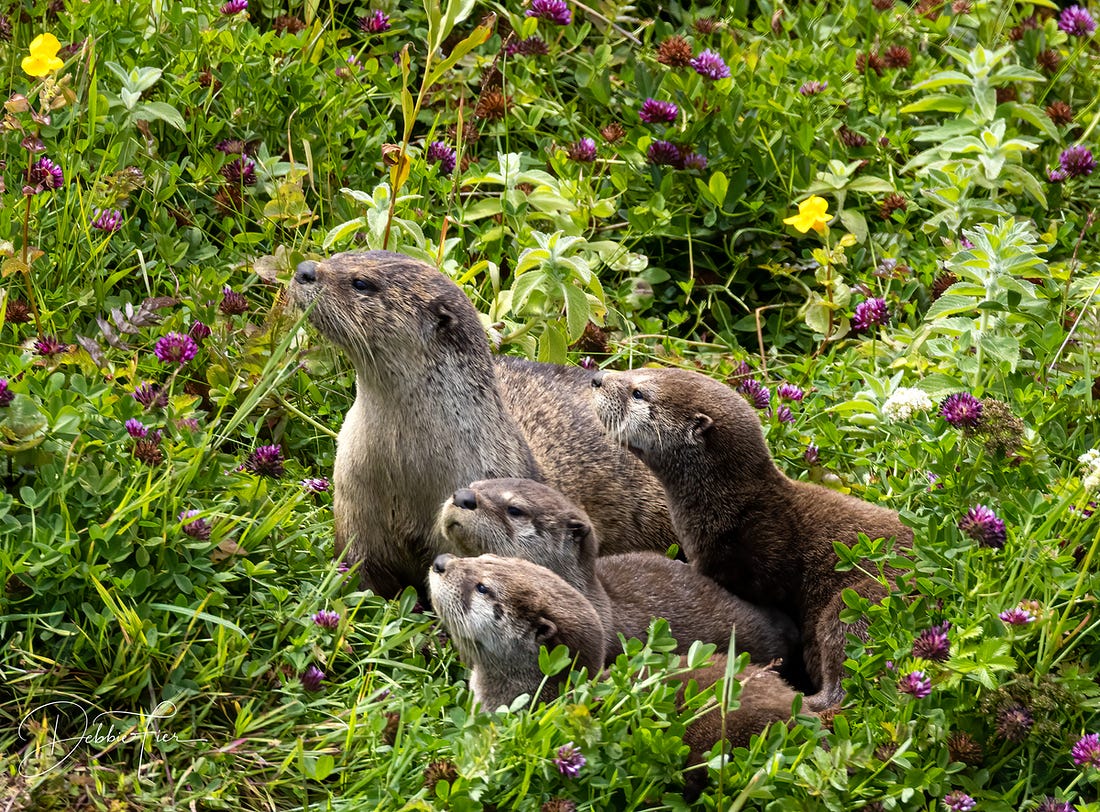
River otters have staged a remarkable comeback across North America’s Great Lakes after disappearing from many waterways by the 1970s. Reintroductions beginning in the 1980s, combined with wetland restoration and pollution controls under the 1972 US–Canada Great Lakes Water Quality Agreement, have allowed breeding populations to recover across Ohio, New York, Ontario and beyond. As apex predators, their return signals cleaner water and healthier ecosystems. Rewilding Magazine
And an image from my collection:


 Laugh / learn links log