Ukraine using AI to train war robots

I saw this headline and immediately said to myself, We are now officially living in the future.

AI has been deployed by both sides on the battlefield during Russia’s invasion of Ukraine to identify targets, scanning images far quicker than a human can….

Kateryna Bondar, a fellow at Wadhwani AI centre at the Centre for Strategic and International Studies, said the size of the data set and the image quality were important, as AI models learned to recognise targets based on shapes and colours.

Bondar said that the dataset was valuable in the context of training to fight Russia. However, she said U.S. officials and drone makers prefer a dataset that trains AI systems to operate in the Pacific against a potential Chinese adversary.

Full article: https://www.reuters.com/technology/ukraine-collects-vast-war-data-trove-train-ai-models-2024-12-20/, about 625 words, or https://gizmodo.com/ukraine-is-using-millions-of-hours-of-drone-footage-to-train-ai-for-warfare-2000541633.

Truckers love EVs

While trucks are only 4 percent of the vehicles on the road (in the US), they make up almost a quarter of the country’s transportation emissions. Around 10,000 of those trucks were just put on the road in 2023, up from 2,000 the year before.

Amazon, for example, has ordered and deployed thousands of electric delivery vans made by Rivian; the company says it has electric trucks operating in 1,800 cities in the United States. FedEx has electric trucks rolling through the streets of Los Angeles. The logistics company Schneider has dozens of Class 8 electric semi-trucks delivering loads throughout Southern California.

And the drivers operating them say they love driving electric. Marty Boots, a 66-year-old driver for Schneider in South El Monte, Calif., appreciates the lightness and the smoothness of his Freightliner eCascadia semi-truck. “Diesel was like a college wrestler,” he said. “And the electric is like a ballet dancer.”… Some drivers were hesitant when first trying out the technology. But once they try it, he said, most are sold. “You get back into diesel and it’s like, ‘What’s wrong with this thing?’” he said. “Why is it making so much noise? Why is it so hard to steer?”

Many drivers have reported that the new vehicles are easier on their bodies — thanks to both less rocking off the cab, assisted steering and the quiet motor. “We’re seeing people who would retire driving a diesel truck now working more years with an electric truck.”

Full article: https://www.washingtonpost.com/climate-solutions/2024/01/18/electric-truck-drivers-vehicles/ (1,200 words). Let me know if you can’t access that.

UK closes last coal power plant

Britain was the birthplace of the industrial revolution, around 1780, and a major reason was that coal was plentiful and accessible. On September 30 2024, its last coal-powered electrical generating plant closed, replaced by natural gas, nuclear, and renewables:

This was a country powered by coal — dug by a million miners, used to make cheap energy, to generate heat, then steam, then electricity. Coal heated the homes, ran the trains and made the steel and cement.

The first coal-fired electric plant in the world was built in England in 1882. The term “smog” was coined here, too.

Now Britain is the first in the global club of wealthy countries to quit coal — relying instead on natural gas, nuclear power and a combination of renewable energy sources.

We’re moving into the future. Link: https://www.washingtonpost.com/world/2024/09/29/uk-last-coal-power-plant/ (about 1,400 words). Also see https://xkcd.com/2992/ (remember to hover over the pic for an extra joke).

And just one good news item from this week’s Fix the News:

A lead-free future
Lead poisoning kills more people than HIV and malaria combined. Now the first-ever global public-private partnership has committed $150 million to end lead poisoning in children in developing countries once and for all. Over the past few years Bangladesh, Malawi and Madagascar have all achieved outsized impact in fighting lead expose with low-cost and effective approaches. 

Polling problems

This does not bode well for pre-election polls…

These are strange times for survey science. Traditional polling, which relies on responses from a randomly selected group that represents the entire population, remains the gold standard for gauging public opinion, said Stanford political scientist Jon Krosnick. But as it’s become harder to reach people on the phone, response rates have plummeted, and those surveys have grown exponentially more expensive to run. Meanwhile, cheaper, less-accurate online polls have proliferated.

“Unfortunately, the world is seeing much more of the nonscientific methods that are put forth as if they’re scientific,” said Krosnick.

…In one test of opt-in polling, 12 percent of US adults younger than 30 claimed that they were licensed to operate a nuclear submarine. The true figure, of course, is approximately 0 percent.

Full article (approx 2,800 words): https://arstechnica.com/science/2024/06/the-job-of-pollsters-has-become-much-harder-heres-how-theyre-responding/.

And more good news from Fix the News:

Medicare negotiates prescription drug prices in US for first time 
The White House has secured new, lower Medicare prices for ten of the most costly drugs, potentially saving billions of dollars a year for taxpayers and beneficiaries. The reductions, which range from 38% for the blood cancer drug Imbruvica to 79% for the diabetes drug Januvia, take effect in 2026. ‘No one should be forced to choose between filling their prescriptions or filling their grocery carts.’ NPR

Why no Roman industrial revolution?

Why did the industrial revolution happen in Great Britain in the 1700s and not during the Roman Empire (or anywhere else) in, say, 200 AD? It turns out to be complicated, and modern historians took a while to fully unravel this.

The simple answer is, no one else had the multiple prerequisites. Great Britain was running out of wood for fuel, did have coal easily available up to a point, had practice (with all of Europe) producing precision metal cylinders (admittedly for cannon, but the knowledge was adaptable to steam engines), and had a use for the power from the steam engines. Two uses, in fact: pumping water out of the coal mines as they got deeper (and what luck! right there is the fuel for the engines!), and textile manufacturing on scales that had not previously existed. Neither the Romans nor any other economy had all these features in one place.

A long story (5,800 words) but fascinating to see how the modern world was created: https://acoup.blog/2022/08/26/collections-why-no-roman-industrial-revolution/.

And more good news from FutureCrunch (now Fix the News):

22 years after The Wire, Baltimore reports 36% decline in homicides
According to the Baltimore Police Department, these numbers for the first half of 2024 are on top of a 20% reduction in homicides in 2023. The new figures also show that non-fatal shootings declined by approximately 30% in H1 2024. City leaders have attributed this to community outreach and long-term efforts to regain public trust as well as ‘the collective efforts of [the] entire public safety apparatus.’ Hoodline

ChatGPT and calendars

I’m working on an algorithm to determine the dates of holidays, for example, Labor Day is the 1st Monday in September (thus September 2 for 2024… anywhere from the 1st through the 7th depending on the year). Just a little hack that I felt like doing. Well, it’s slightly complex, so just for fun I decided to ask ChatGPT how to do it.

ChatGPT did an excellent job… but the (my bolding) warning at the end was a surprise:

Me: How do I calculate which day of the month is, for example, the third Thursday?

ChatGPT:

To calculate which day of the month is, for example, the third Thursday, you can follow these steps:

1. Determine which day of the week the first day of the month falls on.

2. Find the day of the week that corresponds to the desired weekday (e.g., Thursday).

3. Add the appropriate number of days to the first occurrence of that weekday in the month to find the desired occurrence (e.g., third Thursday).

Here’s a more detailed breakdown:

1. Find the day of the week for the first day of the month using any method (e.g., a calendar, programming libraries like Python’s `datetime` module).

2. Determine the difference in days between the desired weekday and the day of the week of the first day of the month.

3. Calculate how many days you need to add to the first occurrence of the desired weekday to reach the desired occurrence (e.g., third Thursday).

For example, if the first day of the month is a Monday and you’re looking for the third Thursday, you’d add 4 days (Thursday minus Monday) to the date of the first Monday to find the date of the first Thursday. Then, you’d add (3 – 1) * 7 days to find the date of the third Thursday.

Keep in mind that this calculation might involve considerations for leap years and edge cases where the month doesn’t have the desired occurrence of the weekday (e.g., if there are only two Thursdays in the month).

And more good news from FutureCrunch (now Fix the News):

Humanity sees significant decline in tetanus-related fatalities

Tetanus, a bacterial infection that causes paralysis and can be fatal, claimed over 250,000 lives annually in the early 1990s. By 2019, the number of deaths had plummeted to fewer than 35,000 per year—largely thanks to widespread administration of the combined diphtheria, tetanus, and pertussis vaccines. OWD

Math jokes

And several other kinds. (You will need some specialist knowledge to get some of these.) If eleven pages of this aren’t enough, check the comments from the tech people on Hacker News. Some examples:

—Why did the chicken cross the Mobius strip?
—To get to the other… er, um…

Not all math puns are terrible. Just sum.

The barman says, “We don’t serve time travelers in here.”
A time traveler walks into a bar.

Eleven pages: https://arxiv.org/pdf/2403.01010.

Hacker News: https://news.ycombinator.com/item?id=39659383.

And more good news from FutureCrunch (now Fix the News):

50 years of global immunisation

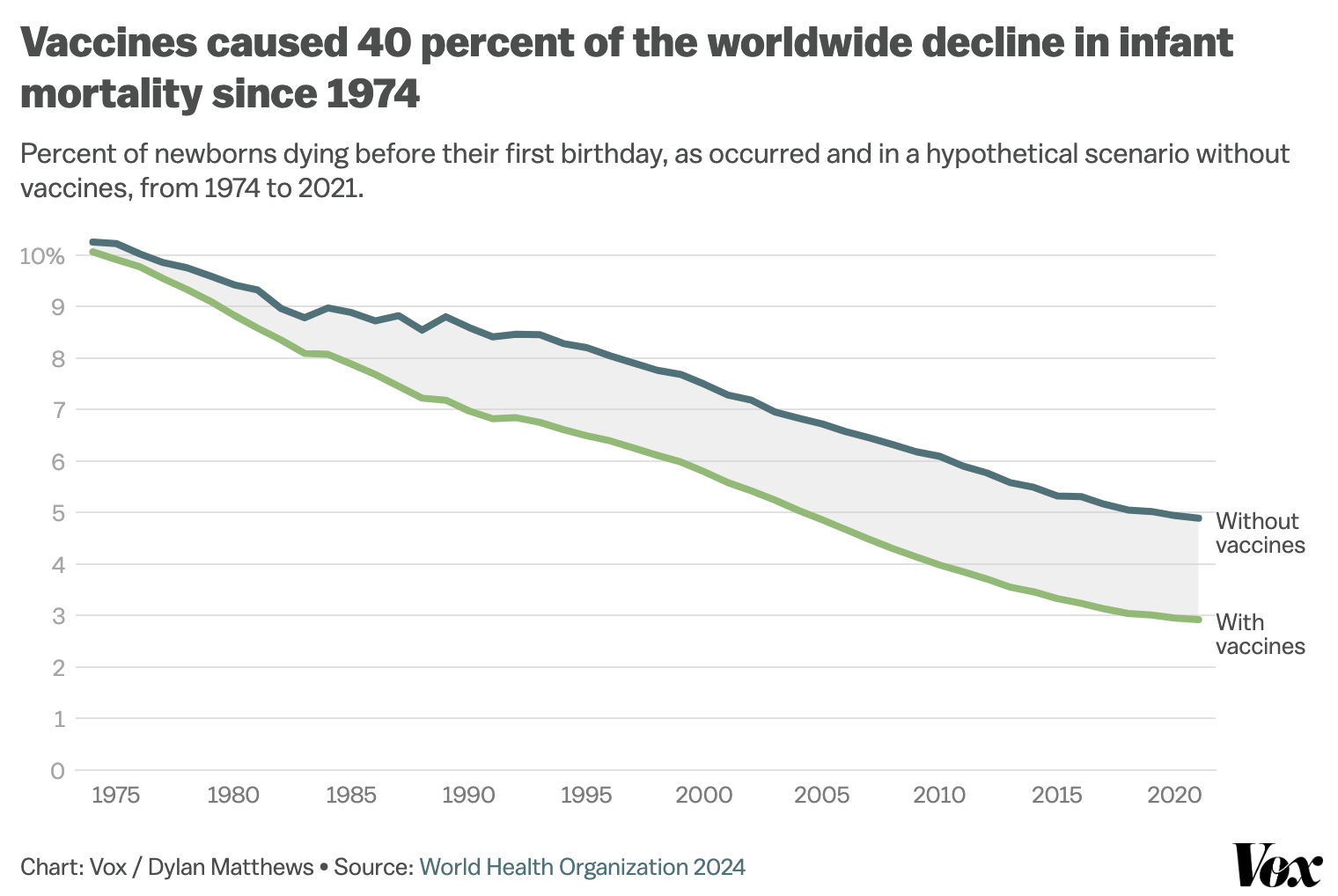
A new report estimates that since the 1970s, global immunisation efforts have saved an estimated 154 million lives—the equivalent of six lives every minute of every year. Vaccination against 14 diseases, including diphtheria, measles, polio, rubella, and tuberculosis, has helped reduced infant deaths by 40% globally and by more than 50% in Africa. VoxWHO.

Vaccines are among the most powerful inventions in history, making once-feared diseases preventable. Thanks to vaccines, smallpox has been eradicated, polio is on the brink, and with the more recent development of vaccines against diseases like malaria and cervical cancer, we are pushing back the frontiers of disease. WHO Director-General, Dr Tedros Adhanom Ghebreyesus

EVs help people who breathe

Hundreds of infants’ lives would be saved and millions of children would breathe easier across the US if the nation’s power grid depended on clean energy and more drivers made the switch to zero-emission vehicles, according to a new report from the American Lung Association….

Electric cars and trucks are better than gas-fueled vehicles because over the course of their lifetime they emit fewer carbon emissions. EVs create 3,932 pounds of carbon equivalent per year, compared to 11,435 for gas powered vehicles, according to calculations from the US Department of Energy. ((Some emissions occur during EV and battery construction and from recharging.))

This latest report estimates that by 2050, a switch to zero-emission vehicles and a decarbonized electric grid would mean 2.79 million fewer pediatric asthma attacks, 147,000 fewer pediatric acute bronchitis cases, 2.67 million fewer cases of pediatric upper respiratory symptoms and 1.87 million fewer cases of pediatric lower respiratory symptoms, and 508 infants’ lives would be saved.

The research comes from a larger American Lung Association report that said a big push for zero-emission vehicles would create more than $1.2 trillion in health benefits for the US by 2050… Globally, 8.8 million people die prematurely because of air pollution every year.

((Bolding is mine.)) https://www.cnn.com/2024/02/21/health/electric-vehicles-air-pollution-kids/index.html. 1,200 words.

ChatGPT 3.5 available for free

The famous Large Language Model is now available for free, no account needed. (Note that the premium and superior version is 4.0… possibly later by the time you read this.) https://chat.openai.com/

And more good news from FutureCrunch (bolding mine):

Three countries making uncelebrated progress on poverty
Uzbekistan has witnessed a sharp decline in child poverty, falling from 21.5% in 2021 to 13.7% in 2023; in the Philippines, a new report estimates the poverty rate could soon fall to single digits; and in Cambodia, average incomes have grown fourfold since 1990 and average schooling has increased from 2.4 to 5.1 years.

Alzheimer’s progress

For years, Alzheimer’s conferences were like the obituary pages in the local newspaper: It’s where clinicians and researchers in the field went to find out the names of the latest promising drugs to die. Between 1998 and 2017 alone, 146 clinical trials of new Alzheimer’s drugs failed…

The big potential benefit (of new drugs), say Alzheimer’s experts, lies in using these drugs, or others soon to come, in conjunction with a second recent development in the field: diagnostic blood tests that can identify the presence of Alzheimer’s-associated proteins…. Scientists believe that in a few years clinicians may be able to use them to make quick, early diagnoses cheaply, even before patients show any outward symptoms. That suggests a new strategy against the disease: GPs could screen otherwise healthy people for early-stage Alzheimer’s and treat them with drugs that slow the progress of the disease before major damage has occurred. The hope is that eventually, Alzheimer’s will no longer be a terminal disease but a chronic one that can be managed with drugs and perhaps be staved off indefinitely.

Full article also covers the history of the disease, why it was so hard to develop effective drugs, and how PET scans (to detect amyloid and tau in living people) were a game-changer. And remember, this is just the start — the future will only bring better treatments. 4,400 words: https://www.newsweek.com/2023/10/20/can-we-prevent-alzheimers-scientists-say-new-tests-treatments-game-changer-1832957.html.

Bonus: an item from FutureCrunch:

Ten people died from unprovoked shark attacks globally in 2023, a slight uptick over the five-year average. This makes sharks less dangerous than lawn mowers, ladders, champagne corks, jet skis, and lightning strikes. 

Guess which one of those things got an entire article in ABC News?