According to textbook economics, the stock market’s value reflects what are known as “fundamentals.” An individual company’s current stock price is derived from that firm’s future-earnings potential, and is thus rooted in hard indicators such as profits and market share…
The fundamentals story held up well until the 2008 financial crisis. Within six months of the U.S. banking system’s collapse, the market fell by 46 percent. In response, the Federal Reserve cut interest rates to almost zero and pushed money back into the economy by purchasing trillions of dollars in securities from financial institutions… For most of the 2010s, corporate earnings were modest, GDP and productivity growth were low, and the labor market remained weaker than it had been before the crisis. In other words, the fundamentals were not great. Yet the stock market soared. From 2010 to 2019, it tripled in value.
More than half of the S&P 500’s total growth in 2023 and 2024 was driven by the so-called Magnificent Seven companies: Apple, Amazon, Alphabet, Meta, Microsoft, Tesla, and Nvidia. During those two years alone, Tesla’s value rose by 286 percent, Meta’s by 355 percent, and Nvidia’s by 861 percent. The biggest firms have always been responsible for a disproportionate share of the market’s growth, but never had the gains been so acutely concentrated.
So what the heck is going on?
Thanks to a series of regulatory changes in the late 2000s and early 2010s, about half of fund assets are now held in “passive funds.”… The most common type of passive fund purchases a tiny share of every single stock in an index, such as the S&P 500, proportional to its size.
We have a positive feedback loop here, friends. “Positive” does not mean “good,” it means “self-reinforcing.” A negative feedback loop tends to suppress its own growth: for example, a thermostat raises the heat if the temperature is too low, or raises the A/C if the temperature is too high. An example of a positive feedback loop is a microphone that’s too close to the speakers: it picks up music or speech, plus the sound from the speakers, and feeds that to the speakers, which get louder, and repeat until screech. Unregulated positive feedback loops always end in disaster.
As the “Magnificent Seven” become larger parts of the Fortune 500, passive funds buy more. Which makes the Seven larger, so passive funds buy more. Repeat until… well, I don’t know what will happen. But it will probably be unpleasant.
And good news from Fix the News: Sometimes no news really is good news!
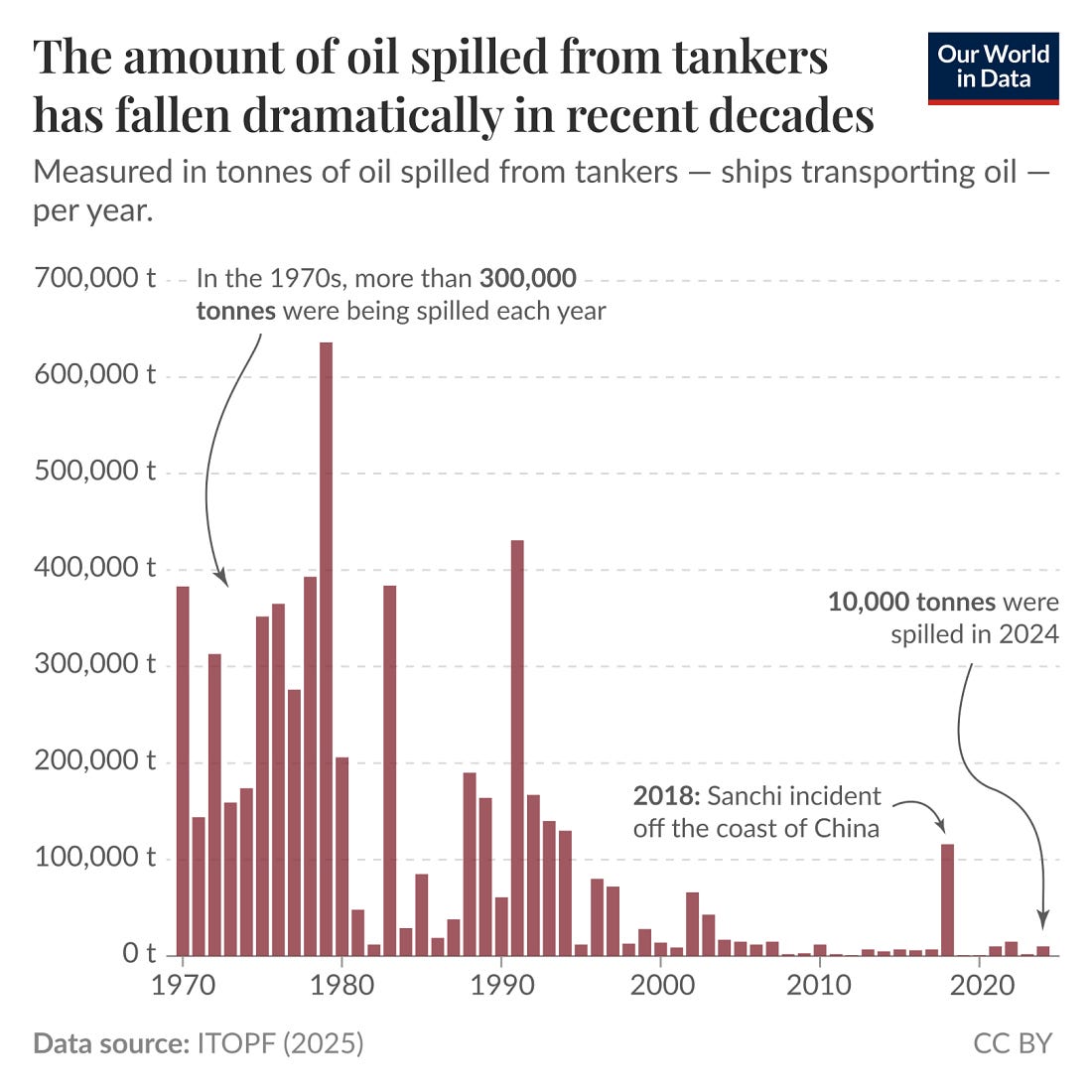
Oil tanker spills have nearly vanished since the 1970s. Half a century ago, spills released an average of 314,000 tonnes of oil into the ocean each year. However, better ship design, stricter regulation, and faster response capacity have turned once-routine disasters into rare events; today, the figure is below 10,000, less than one-thirtieth of its former level.Our World in Data
In my opinion, we’re living in a Golden Age, especially regarding healthcare. But these numbers are pretty astounding: global GDP in the year 1 was around $248 billion, in 1001 around $285 billion (up about 15%), in 1993 around $62 trillion (up around 24,876%). It’s routine to build massive civilian infrastructure: roads, hospitals, schools, bridges, and not just out of wood or stone anymore…
This article has some more detail: https://www.visualcapitalist.com/mapped-gdp-per-capita-worldwide/: “In 1990, 1.9 billion people lived in extreme poverty, which was 36% of the world’s population at the time. Over the last 30 years, the number has been steadily decreasing — by 2030, an estimated 479 million people will be living in extreme poverty, which according to UN population estimates, will represent only 6% of the population.”
This is a growth rate of world GDP of 87% in the 120 years 1700-1820; 311% in another hundred years from 1820-1920; and 2,390% in 103 years from 1920-2023. What will just the next 25 years present to us?
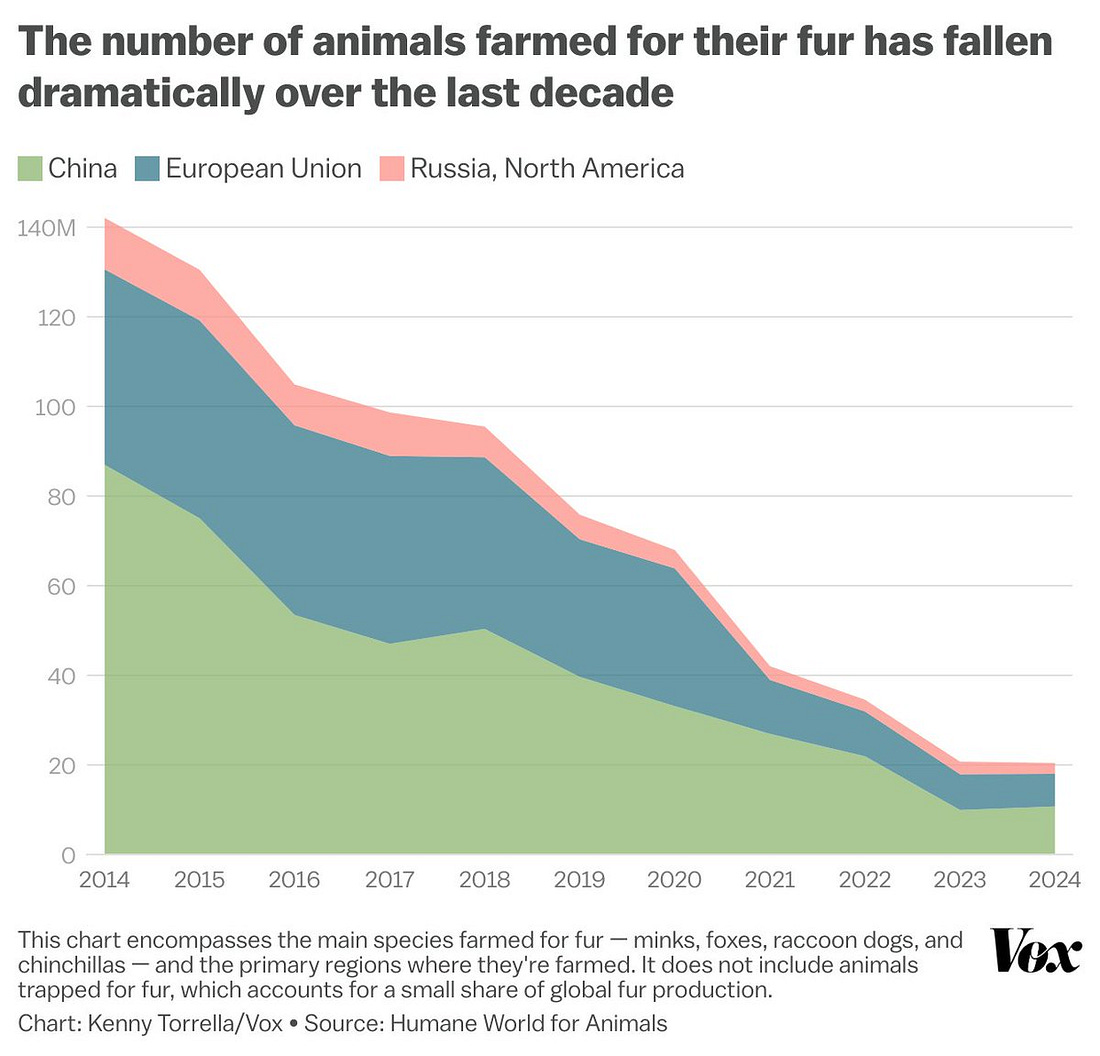
Check out fur’s fall from grace: a $40 billion industry gutted in a decade. In 2014, fur farms killed over 140 million animals. By 2024, that number was down to 20.5 million. The collapse came fast: Gucci’s 2017 fur-free pledge set off a luxury brand exodus, COVID-19 outbreaks on mink farms shut down operations across Europe, and sanctions and crackdowns hit demand in Russia and China. Vox says it’s the greatest animal welfare victory of the 21st century.
Two years ago, a Canadian writer named Cory Doctorow coined the phrase “enshittification” to describe the decay of online platforms. The word immediately set the Internet ablaze, as it captured the growing malaise regarding how almost everything about the web seemed to be getting worse.
“It’s my theory explaining how the Internet was colonized by platforms, why all those platforms are degrading so quickly and thoroughly, why it matters, and what we can do about it… We’re all living through a great enshittening, in which the services that matter to us, that we rely on, are turning into giant piles of shit. It’s frustrating. It’s demoralizing. It’s even terrifying.”
Doctorow believes there are four basic forces that might constrain companies from getting worse: competition, regulation, self-help, and tech workers. One by one, he says, these constraints have been eroded as large corporations squeeze the Internet and its denizens for dollars.
Ars Technica covered several areas of enshittification:
Poland repeals its last anti-LGBT+ resolutions. In 2019 and 2020, over 100 local authorities around Poland adopted sometimes-thinly-veiled anti-LGBT+ resolutions, declaring themselves free of “LGBT ideology” or pledging to “protect children from moral corruption.” Last week, the last of those declarations was revoked after the EU threatened to deny those regions funding, marking the end of Poland’s so-called ‘LGBT-free zones.’ Human Rights Watch.
In Detroit, for instance, city officials say the number of homicides is at its lowest since 1965, and Police Chief Todd Bettison says that has led to a huge difference for his officers.
“They’re not drinking from a fire hose,” he says….
Crime analysts have zeroed in on what they say is a primary driver of the rise and subsequent decline: the COVID-19 pandemic.
As of July 1, 68 people in Baltimore had died by homicide this year, the fewest during the first six months of the year in more than five decades. It marks a nearly 23 percent decrease compared with the first half of 2024. Shootings where nobody was killed have also fallen by nearly 20 percent compared with the same time period last year. The falling statistics, mirroring a national drop in violent crime, follow years of similar declines.
Government spending makes a difference:
All of a sudden, there were a lot of young people — who are more likely to commit crimes than older people — at home, with little to do. And, Roman says, a vital support system was ripped away: public services. Between March and May of 2020, the country’s local government workforce shrank by nearly 10%.
Global progress on trachoma elimination is one of the best things you’ve never heard about. The number of people afflicted worldwide has fallen from 2.8 million in 2016 to 1.2 million in 2025. The pool of those at risk is shrinking fast too, falling from 192 million in 2015 to 102 million in 2025. In the last 12 months alone, seven countries have eliminated the disease altogether. It’s one of the most amazing global health stories on Earth, and you will not find it anywhere except deep inside technical WHO reports.
Study after study has found that attempts – even by trained police officers – to read lies from body language and facial expressions are more often little better than chance…
“There are no consistent signs that always arise alongside deception,” says Ormerod, who is based at the University of Sussex. “I giggle nervously, others become more serious, some make eye contact, some avoid it.”… The existing protocols are also prone to bias, he says – officers were more likely to find suspicious signs in certain ethnic groups, for instance. “The current method actually prevents deception detection,” he says.
Better:
Shift the focus away from the subtle mannerisms to the words people are actually saying, gently probing the right pressure points to make the liar’s front crumble.
Ormerod and his colleague Coral Dando at the University of Wolverhampton identified a series of conversational principles that should increase your chances of uncovering deceit:
Use open questions. This forces the liar to expand on their tale until they become entrapped in their own web of deceit.
Employ the element of surprise. Investigators should try to increase the liar’s “cognitive load” – such as by asking them unanticipated questions that might be slightly confusing, or asking them to report an event backwards in time – techniques that make it harder for them to maintain their façade.
Watch for small, verifiable details. If a passenger says they are at the University of Oxford, ask them to tell you about their journey to work.
Ironically, liars turn out to be better lie detectors. Geoffrey Bird at University College London and colleagues recently set up a game in which subjects had to reveal true or false statements about themselves. They were also asked to judge each other’s credibility. It turned out that people who were better at telling fibs could also detect others’ tall tales, perhaps because they recognised the tricks.
Observe changes in confidence. Watch carefully to see how a potential liar’s style changes when they are challenged: a liar may be just as verbose when they feel in charge of a conversation, but their comfort zone is limited and they may clam up if they feel like they are losing control.
The aim is a casual conversation rather than an intense interrogation. Under this gentle pressure, however, the liar will give themselves away by contradicting their own story, or by becoming obviously evasive or erratic in their responses.
New York’s six month old congestion pricing scheme has produced perhaps the fastest ever environmental improvement of any policy in US history… and it’s also making money.Congestion pricing revenue is on track to reach $500 million this year, “allowing upgrades to the subway, the purchase of several hundred new electric buses and improvements to regional rail.” Guardian
This unemployed stray cat had no idea he was about to land a full-time job as a dog trainer when he walked into a building looking for shelter… When Sylvester first walked into the Leamington Guide Dogs facility he didn’t even bring a resume… He specializes in “Cat distraction training,” a critical component of guide dog training.
Assam slashes child marriage by 81% in two years. Child marriage in the northeastern Indian state, home to over 30 million people, dropped by 81% between 2021 and 2024, following a statewide crackdown that included thousands of arrests, community outreach, and expanded education for girls. Authorities are now aiming for full elimination by 2026. The shift marks one of India’s sharpest ever reductions in child marriage, tackling a practice long considered socially entrenched. India Today
…since 2015 (one decade). Yes, that’s “trillion” with a “T.” $33,900 billion. $33,900,000 millions.
That amount is “more than enough to eliminate annual poverty 22 times over” when calculating at the World Bank’s highest poverty line of $8.30 per day, the group said in a news release… Billionaires alone — about 3,000 people worldwide, the overwhelming majority of whom are men — have gained $6.5 trillion since 2015.
I found this quote somewhere, and it’s sounding better and better:
No more billionaires. None. After you reach $999 million, every red cent goes to schools and healthcare. You get a trophy that says, “I won capitalism,” and we name a dog park after you. — Mikel Jollett
Younger generations are less likely to have dementia. A huge study of over 150,000 people in Europe, the United Kingdom and the United States has found that people born in the mid-1940s are up to half as likely to have dementia as those born in the 1920s, with the biggest drop among women. Researchers think better schooling, cleaner air, and heart healthcare are pushing the disease back, which could ease the pressure on future nursing homes and carers. Guardian
It seems to me that decriminalizing many kinds of drug use reduces several problems (policing, health care, crimes to raise money for drugs) into fewer, better problems (treatment). Portugal is trying this: “Portugal saw a 75 percent drop in drug deaths since it adopted the same strategy in 2001 through 2022.”
Oregon tried this too, but is backing down since they didn’t see rapid results:
Portugal’s success, they point out, wasn’t achieved overnight or even in three years.
Oregon’s experiment “was not given the time that it needed,” said Tera Hurst, the executive director of Oregon’s Health Justice Recovery Alliance.”…
Hurst and other decriminalization advocates said the law didn’t succeed because of problems with implementation: a failure to fund new treatment services for 18 months after the law passed, a failure to train police on their new role in addressing addiction, and a failure to direct drug users to treatment.
British authorities are using hospital data, youth outreach, and city planning to prevent violence, with incredible results. To take one example, the number of men seeking treatment after Saturday night fights has dropped by 55% over the past decade, with 65% of the decline driven by fewer 18- to 30-year-olds getting into fights. A rise in teetotal 16- to 24-year-olds – from 18% to 28% – suggests changing drinking habits could be behind the shift, alongside preventative policing. The Economist 🗄️
People don’t like abbreviations in texts (and I won’t try to be funny by putting abbrevs here).
Abbreviations in text messages register as insincere to recipients, who then send shorter and fewer responses (if they bother to reply at all). “I was surprised at how significant the negative results were,” David Fang, a doctoral student in behavioral marketing at Stanford University, says. “Abbreviations are quite subtle—they’re not really a blatant transgression. But people can see you’re taking a shortcut and putting less effort into typing, and that triggers a negative perception.”
People described messages with abbreviations as being less sincere than those without any, and indicated that they weren’t inclined to reply.
Interestingly, the effects held true among different age groups—from savvy Gen-Z texters to those who probably didn’t know what half of the abbreviations meant. Though some might think of abbreviations as youthful or hip, young people don’t actually like them. “Younger people dislike abbreviations just as much as older people,” Fang says. “It’s equally negative.”
Crime in the United States has plummeted. So why don’t Americans feel safe? In city after city, violent crime has declined so much that the murder rate in the United States in 2025 may drop to the lowest level since records began in 1960. If those were the good ol’ days, then so are these. NYT
Everyone’s obviously obsessing about Los Angeles right now, but for what it’s worth, here are this year’s murder rates in big US cities as of May 2025:
The above video was in fact generated by an AI video program. Can you see anything that clearly shows it to be computer-generated? This article (3,300 words) shows several AI-generated videos that are very good and would need careful examination to find flaws (also several videos that still have serious flaws).
This has serious implications for political or criminal misuse… maybe generate a video “Show current president declaring war on Australia”…
Global suicide rates have declined by 29% since 2000, marking a major but often overlooked public health success. Narrative violation alert: the drop has been most pronounced in high-income countries, with more gradual progress in others. The trend reflects expanding access to mental health care, public awareness efforts, and means restriction—but further gains will require deeper investment and cultural shifts, particularly in low- and middle-income countries. WHO





 Laugh / learn links log