How do they make the fantastically tiny components of modern computer chips? It took years to figure out multiple layers of technology to accomplish this. For example… hitting 50,000 droplets of molten tin three times each, per second, to produce the necessary amount of light of the proper wavelength. (“How often do you miss a droplet?” “Never.”)
Self-driving cars are dramatically safer than human drivers, not just marginally. Waymo’s robotaxis have covered 220 million paid miles and post 92% fewer fatal or serious-injury crashes than human-driven cars. An independent July 2026 study by the Insurance Institute for Highway Safety found Waymo vehicles involved in 68% fewer crashes overall, though the gap varied by city, 76% lower in Phoenix, just 35% in San Francisco. IEEE Spectrum/IIHS
☝️ Reminder: around 39,000 people die on US roads every year.
Well, Buzzfeed headlines this as “20 Photos That Are So Accidentally Dirty, There’s No Way You’ll Be Able To Keep A Straight Face,” but I’m pretty sure that several of them are not accidental.
Iceland ends its blanket ban on gay blood donors. We noted voluntary blood donation supplying 85% of the world’s blood in Edition 345; now Iceland has expanded the range of people who can give it. Starting this month, the Icelandic Blood Bank has replaced sex- and orientation-based restrictions with individual risk screening, deferring anyone reporting unprotected sex with new or multiple partners in the past four months. Iceland Review
During the August heat wave of 2020, the California Independent System Operator, which manages the flow of electricity for most of the state, declared a Stage 3 Emergency and hundreds of thousands of households lost power in rolling outages.
At the time, the system had less than 100 megawatts of battery storage available. Today, it has more than 17,000 megawatts available.
Californians just made it through the hottest August on record without having to endure any rolling power outages….
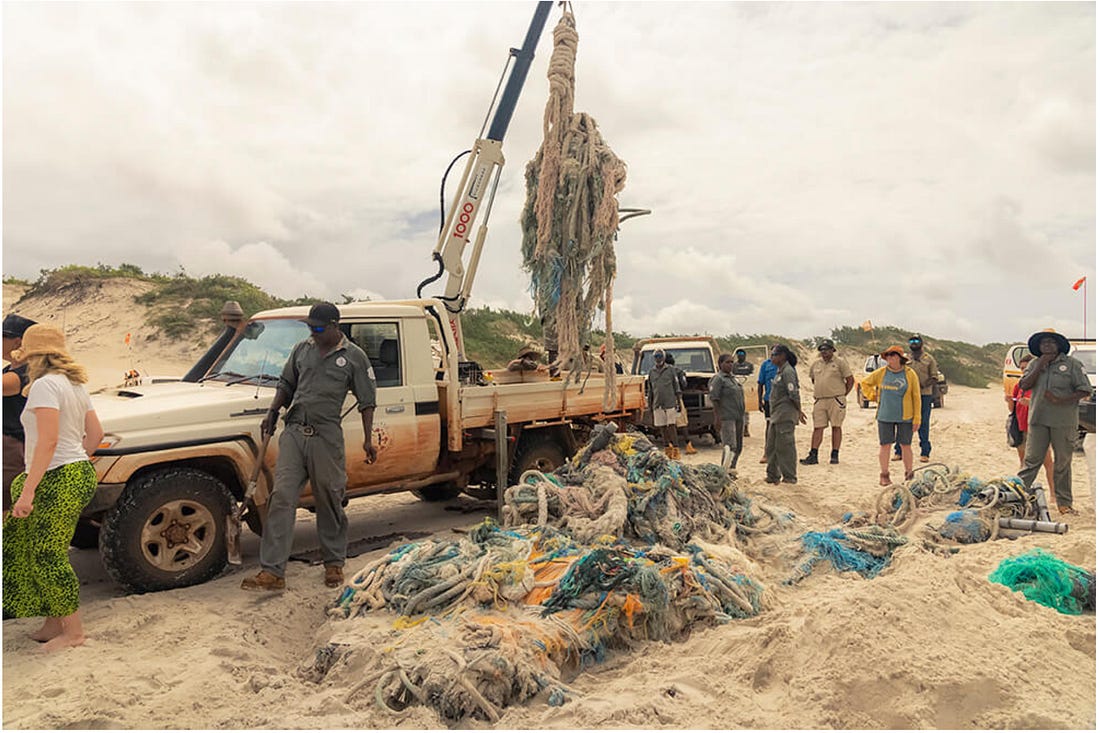
AI-equipped drones are helping Indigenous rangers clear ghost nets from northern Australia’s coast. AI-equipped drones are now spotting abandoned fishing nets from the air, letting Anindilyakwa and Dhimurru ranger teams remove about 15 nets within the course of a single four-hour flight, up against about three nets a day pre-drone. Abandoned “ghost nets” trap and kill shore life, including an estimated 4,000 to 14,000 turtles a year, and a $25 million commitment will now fund cleanup work with Indonesia, Papua New Guinea and Timor-Leste, aiming to clear Australian beaches entirely by 2030. Mongabay
Removing a ghost net on an Australian beach. Photo courtesy of Timothy Hillier/Agency Project.
This is amusing, but what won the LaughLearnLinks Award was the use of “pneumotachometers (instruments to measure volume flow of respired gases)… to determine the velocity, volume, and time scale of blowing through each side of the nose.”
Established in 1991, the Ig Nobels are a good-natured parody of the Nobel Prizes; they honor “achievements that first make people laugh and then make them think.” The unapologetically campy awards ceremony features miniature operas, scientific demos, and “24/7 lectures,” whereby experts must explain their work twice: once in 24 seconds and the second in just seven words.
This year’s awards go to…
Biomechanics: Matilda Brindle, Catherine Talbot, and Stuart West for devising a more precise definition of kissing—“non-agonistic interactions involving directed, intraspecific, oral-oral contact with some movement of the lips/mouthparts and no food transfer”—in ants, birds, polar bears, and humans.
Economics: Paul Piff, Daniel Stancato, Stéphane Côté, Rodolfo Mendoza-Denton, and Dacher Keltner, for amassing evidence that upper-class people are more likely to snatch from a children’s supply of candy, and engage in other kinds of unethical behavior.
Chemistry: Sanchari Banerjee, Nathan Coussens, François-Xavier Gallat, Nitish Sathyanarayanan, Jandhyam Srikanth, Koichiro Yagi, James Gray, Stephen Tobe, Barbara Stay, Leonard Chavas, and Subramanian Ramaswamy for discovering that milk proteins from viviparous cockroaches pack three times as much energy as milk proteins from cows.
Medicine: The late Tokuji Unno, for the study called “How to Blow the Nose—An Aerodynamic Study of the Nose Blowing.”
Biology: João Miguel Alves-Nunes, Adriano Fellone, Selma Maria Almeida-Santos, Carlos Roberto de Medeiros, Ivan Sazima, and Otavio Augusto Vuolo Marques, for gently stepping on various parts of various venomous snakes—repeatedly, at various temperatures at various times of day—to try to learn what does and does not induce a venomous snake to bite a human.
Physics:Randy Hurd, Zhao Pan, Tadd Truscott, Kaveeshan Thurairajah, for theoretical and experimental attempts to design a splash-free urinal. ((Note: I checked the original paper… it has a surprising amount of math.))
Technology: Justin Puma, Zhen Yang, Evan Johnston, Zixin Zhang, Xiaoyi Lan, Lingzhi Zhang, Hongyu Hou, Zixin He, Ali Afify, Megan Creighton, Jianyu Li, and Changhong Cao, for pioneering the use of mosquito proboscises as high-resolution 3D printing nozzles, a process called “Necroprinting.”
Olfaction: Ilona Croy, Tomasz Frackowiak, Thomas Hummel, and Agnieszka Sorokowska, for collecting evidence that babies smell wonderful to their parents but teenagers do not.
Peace: Jaimie Arona Krems, Rebecka Hahnel-Peeters, Laureon Merrie, Keelah Williams, and Daniel Sznycer, for documenting that we value friends who are vicious to people we dislike.
Soil science: Franz Bender, Marcel van der Heijden, Atlant Bieri, and Pia Viviani, for burying 1,000 identical pairs of underpants in more than 25 countries and then digging them up after two months.
The pancreatic cancer pill that got a standing ovation now has full FDA approval. In Edition 341 we told you about daraxonrasib, a pill that doubles median survival for deadly pancreatic cancer, with some patients living for years. Now the FDA has approved it, compressing a process that normally takes months into weeks because the benefit was so large, and the need so urgent. “We can now envisage a future with no chemotherapy needed.” NYT
And an image from my collection. Well, it makes at least as much sense as anti-vaxxers: